
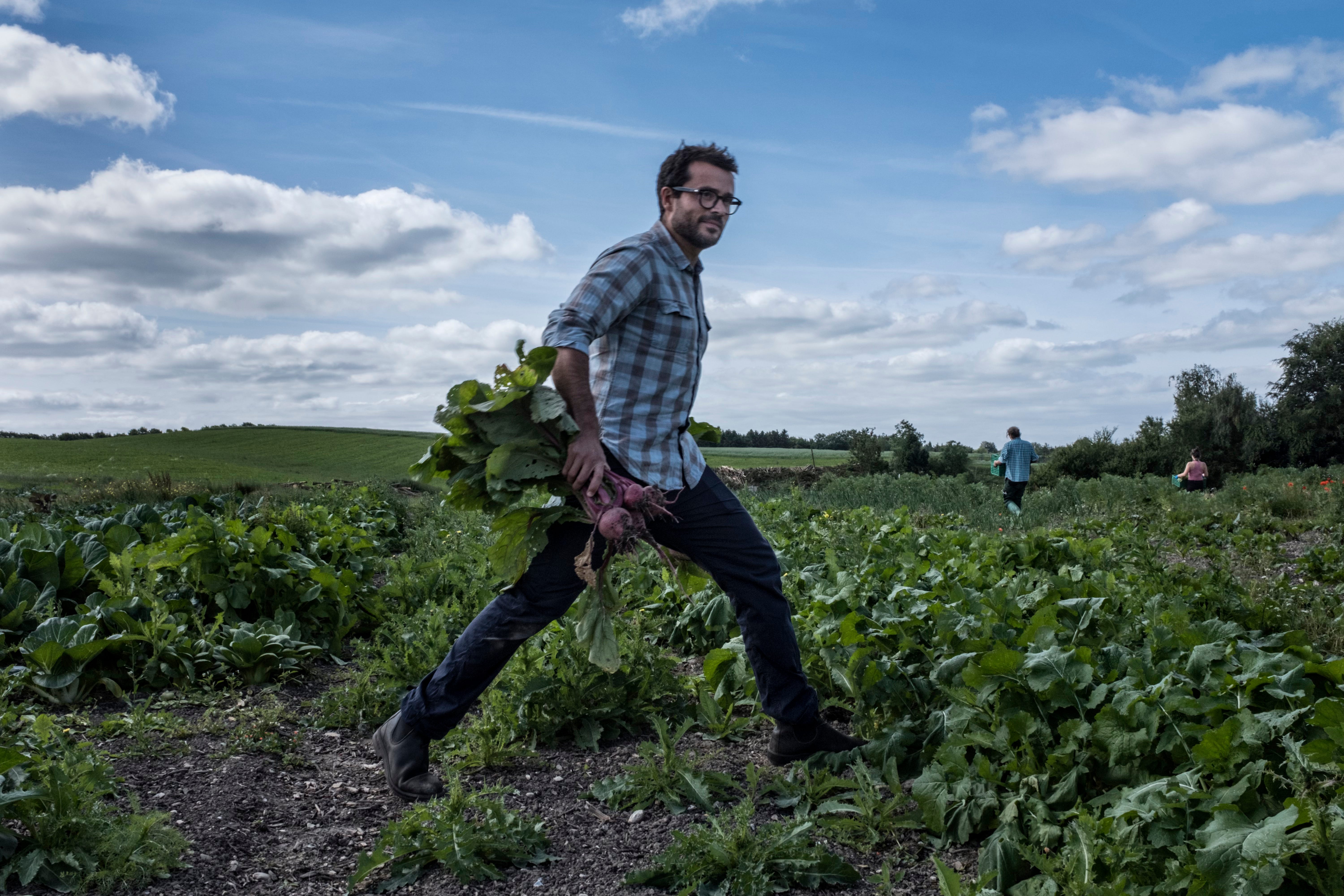
I am an immigrant son of a waiter and a social worker. I grew up in Denmark, which offered me a simple childhood with nothing ever missing. Our small family did well, but it was always clear why: My parents worked hard and toiled for our financial security, and they did so without ever uttering a single complaint. It was a classic working-class background, and no one judged me when I chose a pursuit in cooking and hospitality. I did so after I dropped out of high school for an interim year of doodling around and eventually getting a job as a bellboy in a hotel. On a slow winter day, I was observing a young and pimpled chef apprentice slicing button mushrooms fast enough for me to make that my future path in life.
My mother is Norwegian and a very typical Social Democrat. What else could you expect from a female Scandinavian working with disabled citizens?? My parents were not in any way political, but I was brought up on classical socialist values, with equal parts sympathy for the struggles of the working class and skepticism towards the wealthy capitalist class. Briefly before my culinary adventures, I was really getting into politics, the way you do it when you are 16: Listening to Bob Marley in a Che Guevara t-shirt, I felt I had it pretty much sorted out. The world was unfair, and equipped with Mao’s little red booklet, I convinced my parents to sign me up for a socialist boarding school as a gap year before my brief stint in high school.
As I became a chef and, soon, a business owner at age 27, my egalitarian and progressive values increasingly focused on climate issues and sustainability, and I went from red to green-ish around 2010 or so. My first restaurants, Relæ and Manfreds, were (in my mind at least) restaurants for the people. Relæ was an attempt at making high-end gastronomy accessible for all classes with a 4-course menu priced at 325 kr (50$), and Manfreds was a vegetable-based neighborhood restaurant. Those restaurants were smashing successes, and I credit the hard work and toil my team, my partners, and I put into it for hours on end. The restaurants embraced everyone but shunned the bourgeois idea of the traditional fine dining restaurant and all of its decorum and stuffiness. I was a man of the people, and so were my restaurants.
In 2013, Relæ became the first Michelin-starred restaurant to be awarded a Michelin star AND be certified organic, and my business approach became increasingly idealistic and, to some extent, even political. I eyed a culinary revolution where restaurants, chefs (and me)could champion organic producers and create actual sustainable change for the climate, agriculture, and what the hell, even broader society. The revolution was no longer attended to by wearing a red Che Guevara t-shirt, but in chef whites and Blundstone boots, and Utopia was to be achieved by chefs stepping out onto the fields with their farming comrades and making the world a better place. A red banner with a chef’s knife and a sickle was not far from representative of my sense of a cause. I felt like an activist, and I acted like it: Self-absorbed and better than everyone else. Had you not understood how important it was to choose organic chickens and buy local vegetables from local farmers? You just did not get it.
I was radical, and my timing was perfect because I was in a world that had historically been very conservative and, with the advent of a younger generation of diners, was about to be disrupted. Natural wines in tiny glasses poured with remarkable laissez-faire by bearded waiters, and tattooed chefs serving small dishes marked an incredible shift in values from white tablecloth luxury to loud music and discomfort. From cooking for the elite to cooking for the people.
But I had also become a businessman, and while my roots had allowed me to place a foot in the camp of the supposedly oppressed, my career had, over time, relocated me to the camp of the supposed oppressors. I had gotten that far, fueled by the immigrant mentality towards work. Work hard and do not complain. I was lucky, I have no doubt about it, you can work hard and never be successful. My parents made the best possible call to bring us to Denmark of all places and I owe them eternal gratitude. They are a living example, as every other immigrant is, that even if society might be broken, oppressive, and unfair, you can break your mold and move to better pastures. It has instilled in me a set of values that today clash with what I feel has become the progressive narrative.
The conversation sparked by the Noma Scandal has brought a renewed critique of the restaurant industry and its intrinsic issues, and structural problems. All of which is useful so long as we aim to improve the conditions of our peers. The main issue I have with the debate is how preoccupied it is with pushing people into a box of oppressor or oppressed by removing both from their agency, free will, intentions, and humanity. I see many reasons why a young generation is angry with a system that seems to break down before our eyes. Keeping those in power accountable is as relevant as ever. But using the same axis of oppressed/oppressor locked into a power structure that is necessarily malevolent to explain every single issue will never offer any solutions. It just creates more tribalism and mistrust.
Given my own history and the opportunities that both my parents, the restaurant industry, and the fair, but capitalist, society I live in have offered me, I can feel caught in the line of fire between two standpoints I feel capable of representing. I have strong feelings about global justice, and I have strong feelings about personal responsibility. I am very interested in critiquing “the system,” and I am the greatest supporter of those willing to pursue entrepreneurial ventures in a system that might very well be corrupt and stacked against the individual. I believe in offering equal opportunity to anyone, regardless of skin color, gender, sexuality, or religious belief, and I have the greatest respect for those who have seized the opportunity they have been offered and run with it. The politicizing of these issues, the “you must take a stand” rhetoric, and the public judgment of people not based on what they are actually saying, but on what their position in the power matrix might be, is flattening the discussion into binaries. It becomes us vs them. I don’t feel like them or us, and in return, I have gotten a sense of political homelessness that I cannot seem to make sense of. Am I still a progressive? Or did the progressive movement move on? Did I simply grow?
This piece is based on thoughts I expressed in this video:


Good writing. Interesting thoughts.
You’re still a progressive. And progressivism didn’t move on without you. It’s both. It’s neither. Life is nuanced and complicated — false dichotomies force false choices. You can be both progressive and a successful capitalist. Don’t let anyone tell you that you can’t.
Here’s a piece I wrote about my own struggles with the topic.
https://edzos.substack.com/p/fairness-in-staffing