
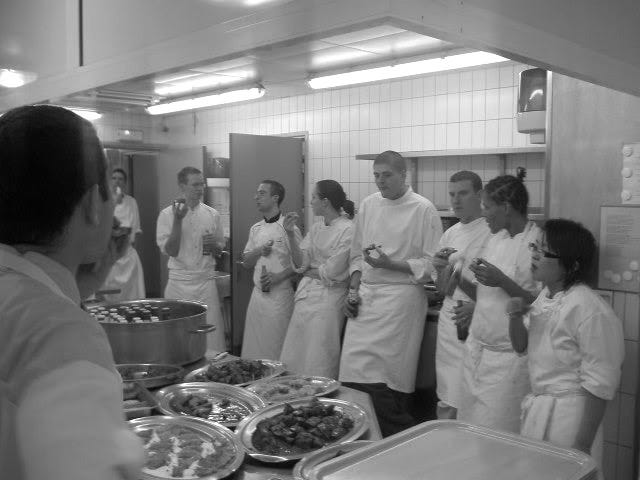
My greatest memories are all from experiencing a group of people becoming a team. A team that reacts to the highest pressure with harmony and focus as it starts moving in synchronous rhythms. When the mackerel is at the pass at the exact moment you need it, and all there is time for is a quick smiling nod to the chef de partie. She knows. She is killing it. When the waiter shows up out of nowhere and picks up the plates the moment they are wiped and ready. When you carve the meat and realize it has rested perfectly, and when you taste the sauce before dressing, you realize it needed correction, and a sous chef has already placed a squeeze bottle of vinegar for you to use. Anticipating your colleagues' needs and getting the same in return gives you the feeling of moving as one unit, and it fills you with incredible confidence and satisfaction. This is when I have experienced cooking at its highest level. As ballet. As a true art form. If you have never been touched by this spirit, you have never worked in a great kitchen or a great restaurant.
The structural issues
As the Noma case moves into its next phase, the restaurant industry is being asked to reckon with its structural issues. One of the main structural issues that have been pointed out, in my mind mistakenly, is the brigade system. This has been made into the culprit of any sort of wrongs and accused of creating an environment that fosters abuse.
While I very much agree that there are plenty of structural issues to address in the restaurant industry, I disagree with which ones are the problem. What most critics seem to ignore is the system’s purpose, the circumstances that created it, and the benefits it might offer.
The Brigade System is simply the traditional French way of organizing a kitchen and a restaurant. It is a hierarchical system that distributes both power and responsibility equally. Many like to compare it with how a military works and call it militaristic. If you today describe just about anything with the words hierarchy, power, and militaristic discipline, a lot of loud voices are ready to condemn it as toxic or even philo-fascist. This ignores the fact that there is a reason why this system works and why we lack other options.
I have written in earlier essays about how the restaurant industry, at all levels but particularly at the highest, is a very high-pressure environment. This is where a comparison to a military unit might be useful. A group of people has a job. It is very high risk. You are under very high stress, and you must focus and communicate as efficiently as possible. Any potential mistake can cost you way more than you wish for. The right kind of system distributes this pressure appropriately within a group, and very efficiently when the group is under pressure. In other words, you can find yourself in high-risk situations where there’s not much time to ask polite questions, be cordial, or acknowledge feelings. While it might be very legitimate to discuss the purpose of a war, it will rarely serve anyone, including yourself, to do so while you are in the line of fire. Likewise, in a kitchen at its peak of service, you depend on the mutual agreement that for the next couple of hours, it is all about business. No chatter, no losing focus, no questioning the plating of the mackerel when you are about to send 12 of them. A ballet or any other live performance lives under the same kind of pressure. What might surprise you is that that is what makes it special, and even at times, fun.
The brigade
The head chef is at the top of the hierarchy, followed by souschefs, chef de parties and commis and in some cultures, like in Denmark we have apprentices. Traditionally the head chef of the restaurant calls out the tickets at the pass, some sort of return call is made by the chef de parties to ensure that the orders coming in have been received. Everyone starts preparing for when the dishes are to be sent out and ultimately, an incredibly intricate coordination of cooked items, raw items, cold items, plates, sauces, spoons to taste, spoons to plate, cloth to wipe droplets of sauce, souschefs and chef de parties scramble in a peak of intensity to send out the dishes well cooked, well dressed, well seasoned, well plated and still warm. This is NOT easy. I have probably tried it for about 10.000 times and I absolutely love it. I love it exactly because it is not easy, and exactly because of the group organization that makes the seemingly impossible possible.
Most of you have probably enjoyed seeing people fail in doing this: for about a decade that was prime time television with Gordon Ramsay yelling at young cooks for not succeeding. But I make the case that the yelling and scolding are not a part of the system - they are a part of the people within the system. Gordon Ramsay made a name for himself by yelling profanities at failing cooks, and he was celebrated for it in mainstream media. That was not about showcasing the restaurant industry’s problems, it was a perverse type of entertainment targeted to those enjoying the comfort of their couch while enjoying the discomfort of those trying. It still exists, though less about kitchens and more about chasing dreams of fame and failing to much laughter and entertainment.
A high-pressure environment requires a system capable of securing the most possible order where the risk of chaos is incredibly high. When head chefs, sous chefs, chef de parties lose their minds, yell at one another, or lash out at each other, the system has failed, and even more so, they have failed the system. The brigade system is deeply professional; sometimes, humans are not. They fail, but the structure and the discipline that emerges in these environments are not there to make people fail; they are there to protect them and the team from failures. That does not mean that it always succeeds.
The system is not dehumanizing; I find it to be quite the opposite. The loudest critics rest on the assumption that when there is a power structure, a hierarchy, when someone has power over another, they will automatically exploit and abuse. I find that claim to be detached from reality. At least the reality I have lived in myself.
When you enter the brigade, inexperienced, you are not asked to face the entirety of the pressure; you are at the bottom level, and you get introduced to it bit by bit. You will not be roasting meat for the main course on your first day. You might be picking herbs, and yes, that might sound boring, but boring and tedious tasks have many lessons to teach, if you are capable of paying attention, focus, and giving it your best effort.
While it has become the mainstream idea that a fine-dining kitchen is but a bunch of dudes kicking down, with the last kid taking the biggest beating, I cannot deny that might happen in some places, but I refuse to make it the default. That does not represent my own experience.
Pushed beyond my limits
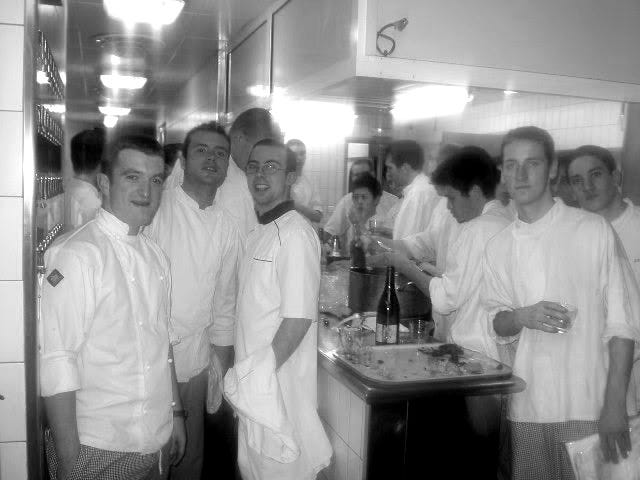
When I was young, I worked for incredible chefs who were tough to the bone but whom I never doubted had my best interests in mind. They were there for me when I struggled, when it was hard, when I could not keep up. At times, that also meant being scolded if I disappointed the team. But effort was what was admired, failure was a calculated risk, and mistakes happened. What was never accepted was failure to show up, being unfocused, hung over, disrespectful towards guests or colleagues. That has, in my career, always given the biggest bollocking, and they were often deserved.
Those chefs also had my back when they pushed me past my limits. When I was told I was ready for a section, I was terrified of or that I had to serve the next course and explain it to the guests. I was pushed beyond my limits by chefs who wished for me to succeed, not chefs who wanted me to fail. Was it scary and intimidating? Yes. Was I afraid at times? Yes. But my role models had a genuine understanding of both the benefits of the brigade system and the humans within it. Failure is no one’s interest, but the risk of it is what makes it inspiring to be a part of. If you are the weakest link in a chain, in a brigade, or in a team, and you are so for lack of experience, and not lack of effort, the brigade system offers you plenty of opportunity for growth, for camaraderie, for friendship, and for having fun while busting your ass.
The spirit I mentioned at the beginning requires a solid system and great humans to interpret it. For men and women to access and experience a world-class team spirit, they must be willing to accept some level of self-sacrifice. You must have your buddies’ backs for yourself to feel protected and strong. I understand that the reward might be hard to make sense of if you have not lived it. If you have not felt what being part of an incredible team effort can do for you, your character, your values and your mental health. This, I believe, is why some are willing to work 16 hours a day cooking strange foods while others cannot see it as anything but structured exploitation.
The cooking life
This life is not for everyone, and whoever says it is not worth the work, trust me, I understand, and at times I agree. What I find completely absent in the current debate is an acknowledgment of the people who simply enjoy this life. At the moment, outsiders are pointing in and shaming cooks and chefs who are expressing any type of admiration for the cooking life, accusing it of normalizing abusive behaviour. Of romanticizing toxic environments. Chances are that they, like me, have seen the beauty you have access to on the other side of toil and hard work. That they, like me, refuse to accept that an entire industry has to be burned to the ground.
I am not making the case that abuse does not happen in a kitchen. It certainly does, and I have seen it with my own eyes. I am not making the case that kitchens are only populated by virtuous men and women; I have seen plenty of self-absorbed narcissism and ego at play during my 25 years of cooking. I have also seen cooks treated unfairly and without respect. I have also seen all of the above behaviour being punished by the system. But I have also seen great people do admirable work and treat colleagues with generosity, sympathy, and plenty of respect.
If you have a better system, please go ahead. I want to know more. But we need to stop telling working people that actually enjoy the loudness, the toil, the ups, the downs, the cooking, the heat, the pressure, the colleagues, the intensity that they should be ashamed of themselves: either for being exploited or exploiting.
One of my favorite moments was an insanely crazy service. We broke the record for covers that dinner service. No man was left down, everyone pitched it, everyone helped. When that last ticket cleared the pass we all started laughing and high-fiving each other. We had many nights of ass kicking but that one stands out to me the most because of how much of a team we were and the joy and gratitude we got from working together.
Great piece. To the people on the outside, the military reference can be off putting. To put this is perspective to non-industry folks, there are restaurants that operate with this system but do not call it a brigade. In the Chez Panisse universe, where I worked most of my career, we never called it this. In fact, we never even used the term "Chef" all that much, preferring, even taking pride in, addressing by name. But make no mistake, this system was still present and for good reason. In high performance spaces whether it be a restaurant, hospital, or law firm, accountability is needed from the ground up and the buck needs to stop with someone. For all the grief people on the outside give this system and like to point out that "the Chef takes all the credit" remember- when things succeed, yes, the chef gets a lot of credit and good ones turn around and give that credit to their team. But when things do not succeed, the chef takes all the blame, deservingly so, while protecting their team from blame.