
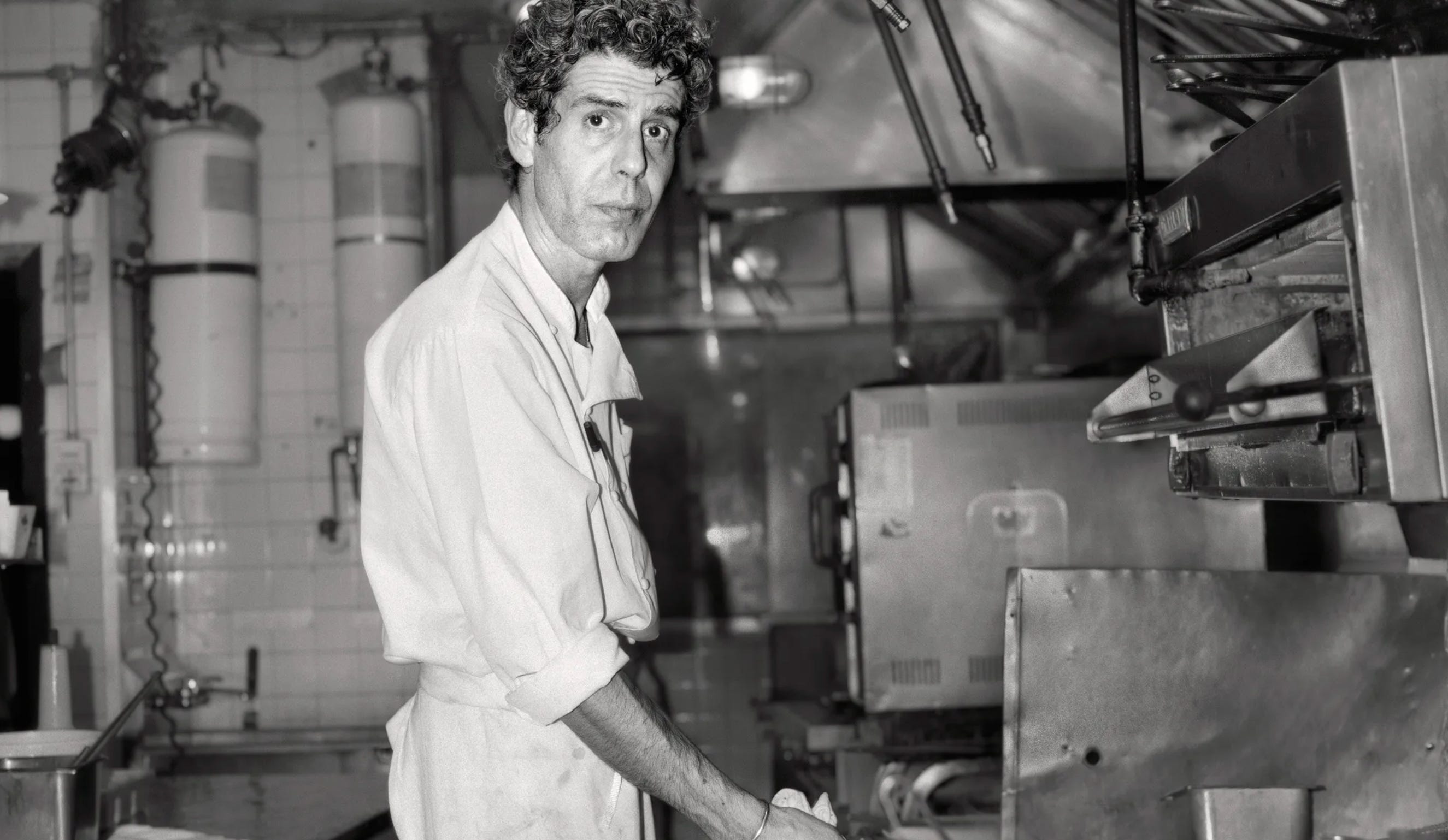
Bourdain’s critics say he romanticized a toxic culture. He himself admitted to doing so. I think they are wrong.
I read Kitchen Confidential in Danish before I went to France to stage in a three-Michelin-star restaurant. In Danish it was called En Køkkenchefs Bekendelser. A Chef’s Confessional. I was 22, working in a kitchen, living a life that most of my friends thought was completely ludicrous. Why would anyone want to live that life? Why would anyone want to work so hard, accept being yelled at, work every weekend?
I didn’t have an answer but what Bourdain called “The Life” attracted me deeply.
In Paris I saw some outrageous stuff. But I was a tourist of sorts; I was staging, interning, and was only there for four months. So I observed and I wrote long emails home about my experience. None of that would have happened had I not read Kitchen Confidential. Anthony Bourdain taught me that the world we were inhabiting carried a story worth telling. And in return I sharpened my observational skills.
The following year I headed for another stage, this time at El Bulli, the world’s best restaurant at the time. I figured the stories awaiting me had to be interesting. I sat down and wrote an essay about my expectations. I sent it to every newspaper and magazine in Denmark. One answered. Politiken, the big left-leaning cultural paper.
I’ll come back to that. First we need to get back to Bourdain.
He gave us a voice
Bourdain gave cooks a voice.
Romanticizing a toxic culture and giving a voice to a subculture, to people who are not normally listened to, not deemed worthy of attention to their story, of who they are, and how they live their life, is the same thing. The difference is the perspective you are looking at it from.
Read it today and you cannot but see it through a lens shaped by the last decade’s sharpened morals. From that vantage point, it is very easy to claim he was wrong in his praise of the foul-mouthed macho chef culture. But for me, as a young chef, he gave me the belief that what I spent countless hours on was actually cool. That I, with my chubby cheeks and paper hat, was a cool guy. Something I desperately needed to know.
Bourdain validated the lifestyle that many of our generation just silently worked our way through without questioning it. At the time you just shut up and got through it. There was no hero to study. No role model to validate us in our own journey. Reading the book from within the environment gave us a language and an understanding of what we were living through, of our lifestyle.
A stage’s confessional
When I was going to the world’s best restaurant, I sent out this essay filled with my dreams and my hopes for what I was about to experience. Politiken picked it up. I ended up writing seven essays about my stay at El Bulli: En Volontørs bekendelser, A Stage’s Confessional.
The reason I am writing my memoir today, the reason I wrote those essays, the reason I make video essays about the kitchen life and what comes after on YouTube, is because of Anthony Bourdain telling me that my story was worth writing.
So he might have given some of us a voice. But was that problematic? Was he causing more toxic behavior going forward?
He was coping
The kitchen gave Bourdain a place where he could be his best self. Where he could get his act together. He was coping.
I might have been different from many of my colleagues. When I was a young cook in an era where sexism was rampant, I was always put off by all the dickjokes. There’s a whole chapter in Kitchen Confidential that is about who takes it up the behind. That sense of humor, honestly, never got me.
This is what I believe is missed in the critique of Kitchen Confidential. Writing a memoir is a way of coping with your own life’s experience, and trying to make sense of it at the same time.
What a memoir is supposed to do is give you, the reader, a position inside the narrator’s interior life, reveal how he observes the world, and what the hell is going on around him. I’m sure the stories are mostly true. The rest, the hyperbole, should be attributed to his capability as a writer, with which he can seemingly make peeling shallots or dicing carrots wildly interesting. It is like having a beer with a crazy chef rambling out extremely entertaining stories–on paper. It required extremely sharp observational skills and talent to pen those stories from that life. Many of us could have lived it and not have seen them unfolding. That is the beauty of the memoir.
Bourdain was a former heroin addict. The man took his own life. It’s an extremely tragic story, and in the end, the life he was living made him pay the ultimate cost. But I don’t think the kitchen life was the culprit. I believe that the book reveals how the kitchen offered him a space where, despite his problems, he had the opportunity to be someone. And by someone I don’t mean the worldwide-famous persona he became, which in the end might have caused him more grief than any of us know or can guess. I mean the kitchen offered him a system, and a set of responsibilities that required him to be conscientious and focused. He writes at length about the responsibility he felt towards his people. His chefs, his brigade, his team, his pirate ship. The kitchen was not the problem. It gave him a space where he could be his best self.
What is a memoir?
The narrator’s one responsibility is to seek the truth. Whether comfortable or not, the one who writes a memoir must tell the truth as they have experienced it. With their flaws, their prejudice, their bias, and essentially their full-fledged humanity. Someone willing to venture into their own interior life and deliver it to you has no responsibility towards whatever moral standards you might have. Without, of course, mentioning the moral standards that you might have 10, 20, or 30 years later.
Which brings me to my point. In modern discussions about toxic kitchen culture, the critics tend to forget one thing: We can think for ourselves. Cooks can think for themselves. You can feel that Bourdain speaks to you in a special way, and at the same time denounce sexualizing and inappropriate jokes.
If you, while reading Kitchen Confidential, are hearing a man romanticizing the circumstances he’s living in, without sensing his clear wish for things to be much better for himself and the people around him, you are not paying attention. Or you are not willing to listen.
We forget that the kitchen life has historically been tough. In a tough environment you get tough people. Tough people are not necessarily the nicest kids on the block. Some of them are great leaders. But some of them, exactly because they are capable of enduring a certain life, are challenged just about anywhere else than in a steaming and loud kitchen. This is the breed of people whom Bourdain describes so well, and while modern kitchens see fewer and fewer of them, I do believe that telling their tale is as important as ever.
When Bourdain wrote about “The Life” he didn’t write a manual for anyone to follow. He wrote a confession. It was how he coped with the situation he was in. He told the truth about what it was like to live in a kitchen, at a time when no one from the outside had any real access.
So what is a memoir for, if not for telling the truth honestly?
And if the truth, told honestly, is still read as an instruction, who is failing?
The writer, or you?
This is very interesting and brought out clearly, those toxic elements are actually the "good Life" being runover by excesses, just like drinking and drinking too much or drinking cheap ripple and getting sick or drinking screaming eagle and waking up feeling better. You have to protect people and view points like his it takes special education to realize the quality he produced , it may actually be genetic and he suffers from prejudice.