
I struggle with back and knee issues and have done so my entire grown life. And though I am uncertain whether to blame my career or modernity, I know the real culprit is my crappy posture. Of course much worsened by realizing there is such a thing as a crappy posture all too late.
In 1999, I enrolled at HRS, the Copenhagen Hospitality School, back when it was in the meatpacking district, and the meatpacking district was an actual meatpacking district. The area was lively with cigarette-smoking butchers, prostitutes, and chefs pushing large carts in and out of INCO, the wholesale-only supplier of restaurants. A mysterious smell still lingered all over the area that had decimated the number of operational slaughterhouses but was not gentrified into a fashionable nightlife district quite yet.
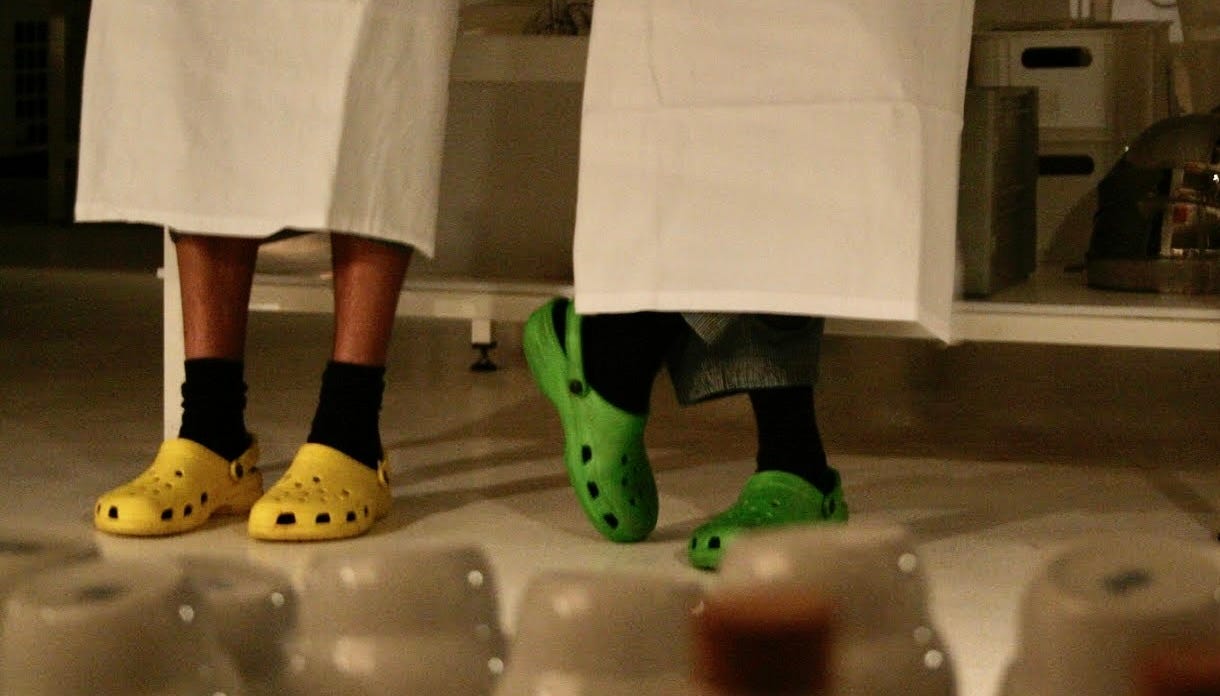
H.W. Larsen was, and still is, where any young aspiring chef apprentice would go to get equipped for the very first time. The store was lined with pots, pans, knives, sieves, cutting boards, and metal hooks of all sizes, and in the clothing area, you would pick up your first chef whites, a pair of wooden clogs, and houndstooth chefs’ trousers. There was no choice in uniform, but butchers wore white clogs, and chefs wore black clogs. Wooden clogs. Yes, wooden.
Even at 17, my joints were not having it, shuffling around school with pieces of wood stuck to my feet. Little did I know that school was the easy part; once the apprenticeship started for real, I would have to stand on those raised wooden heels for up to 14-16 hours a day. My feet were thumping by the end of the day, and my knees were begging for mercy.
The wooden clogs were historically the most comfortable, safe, and affordable cushion against the even harder tiled kitchen floors, but I suppose that feet have become increasingly demanding, and I took mine to look for alternatives. Over the years, I tried everything: non-slip workwear, Blundstones, Birkenstocks. I even had a more enlightened bare-foot shoe phase that conveniently took hold when I was in charge and could sneak off to the office to sit down and let my inflamed heels rest on the desk, Mad Men style. It eventually dawned on me that our barefoot ancestors were not hunter-gathering on tiled concrete floors.
I recently posted a video on YouTube that resonated with the chef community. While mental health has been getting a lot of overdue attention in the last couple of years, in this video, I reflected on the physical toll that kitchen life imposes on you.
It was originally inspired by a comment from a Substack subscriber (unfortunately I cannot find the comment..please let me know if you are out there!) pointing out how taking a seat in the kitchen is (literally) looked down upon, and how absurd that is, it being quite common in non-Western cultures.
Good or bad posture, the main problem with kitchen work is that the long hours of standing in the same place are destructive and rarely strengthen you. The long hours are killing the joints, which suffer from a lack of movement and prolonged pressure. I realized in my 30s that my posture tilted my hips forward, and it triggered a chain reaction up and down. It was only as I picked up sports again around the same age that I started to understand movement differently and take on some corrective measures.
Most modern life requires a sedentary lifestyle, and that brings about a vast range of problems. The chef’s life is primarily standing, which has its own set of issues that must be addressed from a young age. Investing in proper, comfortable, non-restrictive footwear and adopting a workout routine that can help strengthen, and more so, lubricate the suffering joints is an investment that cannot be overlooked if we hope for a long career on a kitchen floor.
I understand why taking a seat seems off-putting, it is a culture embedded in us, and I believe it is out of solidarity with those who simply cannot allow themselves that comfort. Today, we are reluctant to romanticize discomfort, and that is mainly a good thing. I do believe, though, that some cultural pressure can make you achieve things that you did not believe you could. My feet did eventually get used to standing for 16 hours straight. Had I had the opportunity to excuse myself and take a seat at any given time, maybe that would have still been possible, but solidarity and group dynamics will spill over into other situations where they might make a much greater difference and should therefore not be dismissed. If everyone is really busy, and the one odd guy sits down to chill a bit, that will have social implications, and he/she will be looked down upon. If instead we organize some tasks as a group and take a seat while doing it, it might even strengthen the group. Many tedious and repetitive jobs that require a lot of time could very well be done sitting, I believe. Shelling peas, fava beans, peeling onions, peeling walnuts, prepping asparagus. Why not?
Beyond what we can do as a group culturally, we must personally care for our bodies and their individual needs. I understand why many chefs shun the idea of working out on days off, or even before work–who the hell has the energy to lift weights on the way to a 16-hour workday? The key is in finding actual restorative work that helps your body recover. It could be some simple mobility exercises throughout the workday, a couple of squats every hour just to get those knee-juices going, or even some steady-state light cardio on days off.
The last 5-10 years, I have seen the chef community much more inclined towards fitness and movement and less and less towards the alcoholic, cigarette-smoking lifestyle of the old timers, and that is entirely a good thing. At 17 I had no expectations of stepping out of the kitchen and into a much more comfortable life at age 43. What I know for sure is that if I had not had the opportunity to do so, my body would not last another 20 years cooking, that is for certain. Perhaps an earlier physical awareness could have changed that.
Good stuff Chef. As I have continued to age, I have found Pilates mixed with my normal functional strength training has really made a difference in how I am able to move around kitchens and still feel really good. I highly recommend it to all.
A little yoga after service and changing between two pairs of good kitchen shoes always helped me!