Now what?

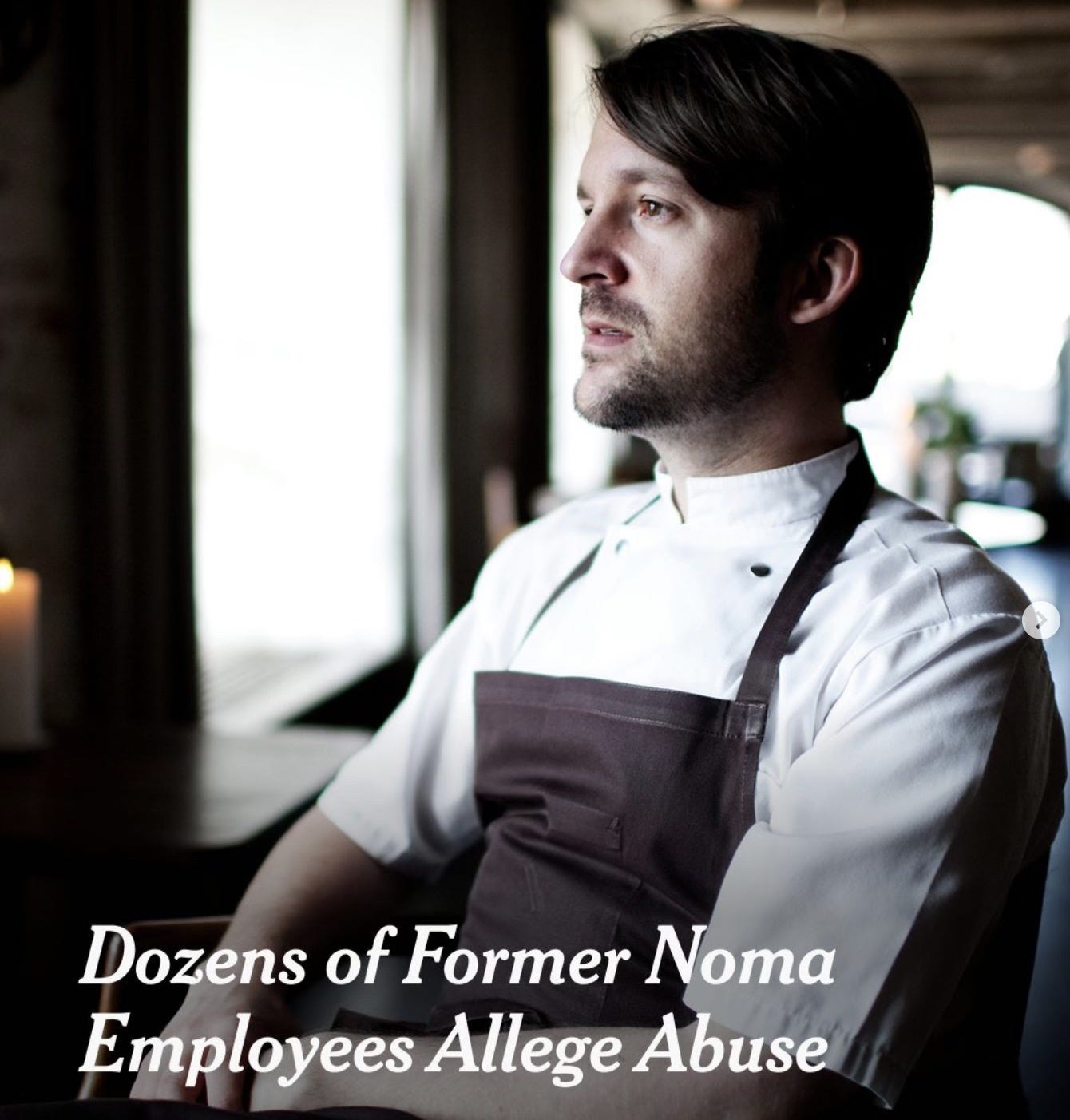
The accounts of physical violence at Noma in the NYT article are both shocking and appalling. No one deserves to be hit, poked, or stabbed for anything you could possibly do in a kitchen, restaurant, or workplace of any kind. Words and interactions can be taken out of context and manipulated, but violence cannot. If what we can read in the article is a fair representation of the truth, it is simply unjustifiable.
The reactions to the article and the subsequent apology from both Renè Redzepi and Noma clearly show the outrage that has built up towards both Noma and Renè over the past months, initially triggered by rumours of abuse circulating on social media.
The validity of those rumours had been hard to assess as they claimed everything from physical abuse by Redzepi to questionable behavior by Noma employees on nights out spanning an undefined timeline. Renè has publicly admitted his inappropriate behavior and shortcomings on several occasions, and whether he has actually improved or has been trying to hide behind PR maneuvers is anyone’s guess, looking in from the outside. Assuming one or the other would be speculation, and speculation is inherently biased. Claims of this severity require more serious investigation for both parties. I must assume that the stories NYT has brought forward are confirmed and due diligence has been offered to both parties.
I have personally not wished to speculate on any of the anonymous claims prior to the article for the same reason. I worked at Noma as a sous chef between 2007 and 2009, and I don’t find that this puts me in a position to confirm or deny any of the allegations.
Some particularly loud critics of mine have then made a great effort in conflating my silence with consent towards abuse. This is an outrageous claim that can only be justified in our current climate of social media, where you can, on one hand, boldly claim that “the victims shall no longer be silenced” and, at the same time, attack the reputation of whoever disagrees with you. If a positive change is the genuine ambition of this movement, one would hope it would commit to an actual dialogue with the industry’s key figures. Instead, it weaponizes loaded words like abuse, toxicity, enablism, gaslighting, power structures, and so forth to knock everyone off the public discourse that dares to do anything but loudly condemn actions they have no insight into.
René Redzepi
The Renè Redzepi I have worked with was highly ambitious, extremely determined, very hardworking, and very ill-tempered and emotionally unregulated. I have seen and experienced him yell at me and others in ways that were completely disproportionate to the claimed wrongdoings we had committed. I saw Renè at his worst when he was the most insecure. Insecure, I believe, about whether what we were doing was in line with his dreams and ambitions. This was in 2007; no one had a clue what Noma could amount to, except perhaps Renè, and it created a pressure gap between what we as chefs were capable of and what Renè believed we could become. I personally grew exponentially under that pressure, but it was indeed not for everyone. What happened in the following years is beyond my direct knowledge, and how Renè has handled the mounting pressure would be to further speculate.
In hindsight, I see his lashing out as a reflection of his ambition. In other words, it was clear to me that his mission was compelling but highly risky. To me, it was equally intimidating and fascinating. It was clear to me that he was bound to go very far, and I was, in return, willing to see how far I could tag along. I believe that I was up for it at the time because my ambition was very much in line with his. We shared ambition and direction for a good period, but it didn’t stay that way. It lasted a couple of years until I had enough and wanted to do my own thing. I was not broken, I was not traumatized, I had not been abused but I can certainly see why some people would have experienced it this way and how his demeanor could have a very different impact on others. He was extremely intimidating, and thinking of it, he can still be intimidating to me today. A man with this level of ambition is scary to most people, and understandably so.
The reason I attribute those characteristics to his ambition and not his persona is because I also experienced Renè Redzepi as generous, honest, benevolent, righteous, fair, polite and even humble. He showed incredible generosity in the early days of Noma, comping meals for young, poor chefs out of pure sympathy. He was incredibly supportive when I resigned and helped me make a name for myself in ways I could never have asked for. I also experienced another shift for the worse when he grew suspicious of my success and started acting less than supportive towards me and disappointing me on several occasions. I also heard plenty of stories of him painting a picture of me that was less than admirable. These are mostly speculations based on stories related to me by 3rd persons. There were not enough to base my entire judgement on him, but enough for me to keep a certain distance. I believe that once I was seen as a potential competitor, I could be a threat to his own ambition, hence the vibeshift. He is, in sum, a complicated person. And so am I.
The restaurant industry
I do not see the world of restaurants as a power system created for abuse, nor am I willing to believe that chefs are abused children reperpatrating the abuse they themselves experienced. The restaurant industry is not an isolated island you can visit for your anthropological studies of the species we want to call “chefs.” The restaurant industry is an incredibly diverse, broad, and complex representation of our society as a whole. The restaurant industry does not have isolated issues with mental health, abuse of power, and bad behaviour–we as a society have these issues, and any high-pressure environment with easy access to alcohol can most certainly bring out both the best and the worst in all of us.
A discussion about how to improve the circumstances and structures that define the restaurant industry should be welcomed at all times. I have yet to meet a chef who disagrees with that. These discussions have been going on since I started hospitality school in 1999, and they have brought about leaps of change for the better. Currently, the discussion has taken on a very different character, implying that the restaurant industry is a tyranny and nothing can change before the tyrants are brought down. “Those in power must be held accountable and they must acknowledge their wrongs” is literally what I can read on social media.
Renè has stepped forward and done just that. He acknowledged that he has gone too far and apologized. He has assumed his responsibilities, he has admitted his issues, and he has sought to repair.
Now What?
Now what? American Express and Blackbird have pulled the plug on sponsoring Noma’s pop-up, and the comment section on Renè’s apology shows how polarized the whole topic has become. Many following up articles are appearing declaring Noma finished and Renè dead. The supposed tyrannical leader of this supposedly corrupt industry is on his knees with the gun to his head. Is this what we needed to make a change? If so, what is the change?
Friends and industry leaders who dare to show support to Renè’s admissions and apology are attacked as enablers of abuse, and the same goes for whoever might show any mercy towards this man we are meant to believe is beyond repair. The accounts of abuse were chilling, but so are the mocking celebrations of the demise of Renè and Noma. Grabbing the opportunity to step on someone lying down is exactly the kind of power structure we wished to protect from, was it not? If you feel morally superior while you celebrate the downfall of others, I am not sure I am ready to trust you and your righteous movement with the future of this industry. Not at all.
The described incidents of violence and abuse seem to date up until 2017. If that is the case, and one would dare to read Noma’s official response as truthful, they took full responsibility and changed practices several years ago: investing in HR departments, mentorship programs, and paying all stagiaires. If the violence, the behaviours, the unpaid labour, and the unprofessional approach to HR are things of the past, then the question remains: What further changes should Noma and Renè undertake to satisfy its critics? That there is no obvious answer to this question should at least make you a little suspicious.
A long history of protests organized by workers’ unions has taught us that workers can demand change and often achieve it. They *can* stick it to the man. They protest, they strike, they stop working and bring the employers–the people in power– to the negotiation table. Outside public pressure can help facilitate and empower the ones it should be about: Noma’s staff. The most pressing question to ask is then the one no one seems to be asking: What does the current Noma staff think? What do they want? What are they asking for?? No one is asking that question, not on social media, nor in the New York Times. If we are to believe that they can only be coerced to work at Noma maybe we should ask them to confirm? Or could it pose a risk to the narrative that has built such great momentum? Maybe, just maybe, the Noma staff does not need you to save them from themselves? That could also be an option. Saving them from the choices they have made and the vision they have wished to partake in. Maybe they actually just want to be let in peace and do their damn pop-up? Is that option really off the table?
If you are so preoccupied with creating a positive change for the poor souls working at Noma, maybe you should reconsider celebrating that Amex pulled their sponsorship and ultimately put their jobs at risk? Consider for a moment that Noma is a team of about 100 people. It is not Renè and a handful of emotionless mercenaries. They are people, they have children, they have jobs they might even enjoy, some have ambitions, and some have shared a dream. Some of them have worked for Noma for 10 years and more!
Consider for a moment that maybe a 1500$ ticket price could be exactly the solution to the problem you wish to solve for them?
Is this a movement?
The planned demonstration against Noma will be held OUTSIDE the restaurant, not inside. This is the most telling part about this “movement”. It might need to be redefined at this point: A movement organizes and mobilizes from within to improve the conditions for a collective willing to fight for their rights. They organize from the inside and can formulate specific demands for negotiation. That is a movement. This comes from the outside, it is fueled by hateful rhetoric and hijacks the lived experiences of thousands and thousands of people with the clearly stated goal to burn down Noma, Renè, and the legacy of all its past and current staff. That is not a movement. That is a witch hunt.
Hi Christian,
You raise some thought provoking points - particularly about the validity of a movement of the outside vs the desires of the team on the inside. And once again your insider's view gives unique insight.
But I think the issue of alleged abuse is too contentious to be laid to rest, despite the organisational and personnel changes that have been made in recent years. Acknowledgement, apology and personal change are important. But those things do not erase the fact that harm occurred, nor do they negate the entitlement of those who say they were harmed to seek justice.
To take an extreme but clarifying example as context; a few weeks ago the British Media was awash with Andrew Mountbatten Windsor's implication in the Epstein Files and his alleged history of vile abuse. If the former Prince were to come forward tomorrow, admit wrongdoing and apologise, that would not invalidate the right of alleged victims to pursue justice. The passage of time or the act of contrition would not cancel that entitlement.
The same principle applies here. Apology and reform matter, but they do not cancel the rights of those who say they were harmed.
I believe we have reached a point were industry leaders have a duty to demand the accountability of our peers, no matter what position they hold, or how intimidating we may or may not find them, in Hospitality and beyond.
Sincerely,
Nicholas
“I was not traumatized, I had not been abused but I can certainly see why some people would have experienced it this way and how his demeanor could have a very different impact on others”
This is textbook gaslighting language. Furthermore, divorcing his actions and abuse from his persona, claiming it comes from ambition is incredibly insulting to anyone who suffered under his leadership.
Abusers are skilled at invoking loyalty in the form of “generosity” which you laid out above, yet in the next moment be an absolute raging psychopath. Both can be true, yet it doesn’t cancel out abuse.