
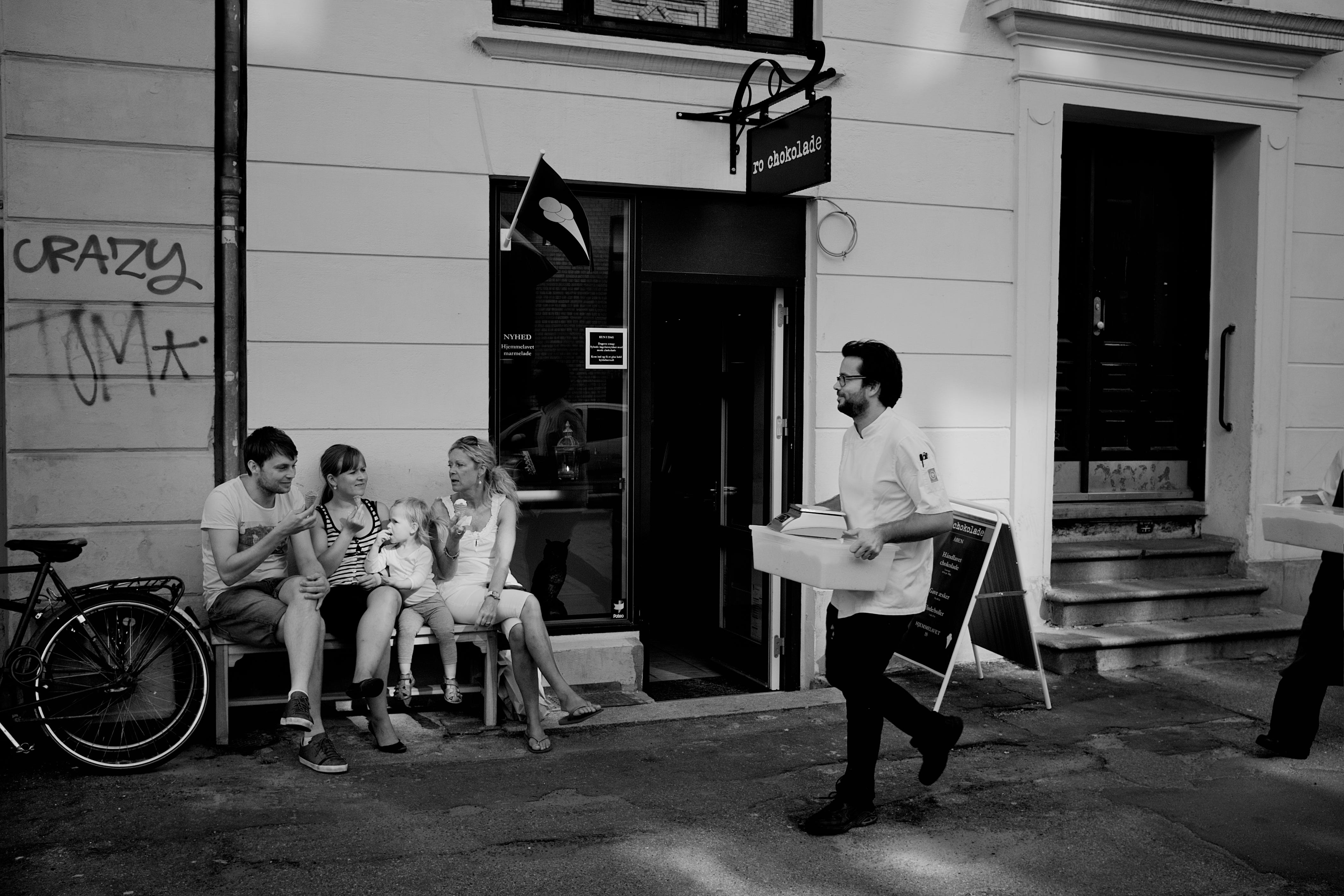
Jægersborggade was a quiet street in 2010. The drug dealers liked it that way, and so did I. The slow street and the dealing offered a very low rent and the opportunity of a lifetime to a young chef: me.
In the midst of the financial crisis, opening a restaurant was senseless. But the hurdles, the complications, the lack of funds, the lack of resources; these were exactly what made the restaurant unique. They forced us to adopt an extremely frugal and lean approach to what was, in reality, an ambitious restaurant.
I insisted on starting without a dishwasher, half from fear of not being able to afford it, half from knowing that the more pressure there was upon us, the more we were forced to think smart and economize with movements and work. Because while I was extremely focused on the intensity I wanted as the base of creative work in the kitchen, I was not, by any means, wishing to work myself to death. Not me, not the staff.
The restaurant, when it opened in 2010, was already on a 4-day work week. We were only open from Wednesday to Saturday. At El Bulli, the days would grow shorter and shorter as the season went by (you were not allowed inside the kitchen before a certain time) because they wanted the tension to be high and still offer a life beyond work. I was inspired to adopt the same principle. We work hard and then we rest well.
There is an unexplainable beauty in trying to overcome with a creative process. Putting your mind and spirit into getting you to places that you cannot buy your way into.
Success takes that from you.
The price of success
It is a paradox: the context that fuels and inspires you is lost precisely because you succeeded at what you dreamt of. Overhead starts creeping in. Bills have to be paid. You start choosing increasingly mainstream ways to move forward because your willingness to take risks is stifled. Suddenly you spend time polishing the edges for no reason other than some abstract idea that more polished must be better, more refined must be better, closer to perfect must be better. When what makes anything stand out is the courage to not polish. To cut through the bullshit and dare venturing into the unknown.
We have seen this happening. A chef opens a tiny place with a singular point of view. The food is strange and personal. People come. Critics come. The place gets busy. The chef expands. More seats. More staff. More covers. I have been there, and I do not blame anyone for adapting to that reality, it would be foolish not to. But successful growth is what dissolves character into the anonymous pond of mainstream.
Same trap, different platform
I have started over. I am experimenting with ways to communicate ideas through YouTube, this newsletter, and social media, and it struck me how similar my situation is to the day I dreamt of a restaurant and was finally handed the keys.
I was faced with the temptation of hiring people to help me edit videos, because this time I have the resources to do so. To overcome my restraints. My thinking was clear: I should not spend time doing things I am not good at. I should not spend time overcoming the struggle of understanding a new platform. I should just do what I am good at. While that is tempting, and while it is what culture tells us to do, I had to stop in my tracks.
I realized I have, again, an opportunity to go where I was the most creatively inspired. Once you put your mind into something you really want to overcome and you have no obvious way to do it, you apply yourself in ways that become your voice. I have struggled trying to edit, trying to film, trying to make sense of how to talk on camera, how to structure a video so it is appealing for people to watch, and to accept the fact that I would have to start over. That I was no expert.
There is another temptation: studying the current recipe for success, rather than forging your own ways. That is what most people do, both in restaurants and on youtube. In 2010 there were not a lot of fine dining restaurants doing very well. It was a completely different scene than it is today. I had no successful template to emulate, so I had to do my own thing. Now, on YouTube, the templates are everywhere. Thumbnail formulas. Title structures. Retention strategies. The advice is polished and convincing and it all points in the same direction: smooth the edges. Optimize. Delegate to grow.
And if you follow that advice far enough, you lose the thing the audience came for in the first place.
The audiences response
I tried to work through this out loud in a video recently, where I cook dinner and reflect. I found, for the first time, some comfort in the shitty editing, the shaky camera, and all the kinks that have become my own particular way of communicating on that platform. The comments told me what I already knew from 2010: the roughness is not a flaw. It is the signal that you are still doing something original.
The growth trap is a trap you walk into one reasonable decision at a time. A dishwasher. A few more tables. An editor. A thumbnail template. Each one makes sense. Each one makes the thing a little less yours.
I have taken plenty of risks in my life. Opening a restaurant. Expanding a restaurant. Walking away from five restaurants at 43. But the risk I am taking now feels different. I am betting that the thing that made Relæ work will work again. That constraint is not the enemy of ambition, it is its preferred partner.
The question is whether I can resist the polish long enough to craft something unique.
Yay! Welcome to Substacks Chef!
when you find a way to save an hour in the kitchen, you get a choice:
keep the hour and try something new, or take more bookings.
that choice keeps coming back ... even when you get better. every time.
your four-day week put a limit on how much of life the work could take. within that limit, finding a better way brings its own pleasure. money can buy equipment and help. it cannot give us the experience of working something out and discovering what we are capable of.
building a business means making choices like these again and again. the plan is a starting point. customers, costs and opportunities keep changing what comes next. we may welcome where it leads and still miss the work we used to do.
some of that we only understand by living through it. giving up a familiar role is hard, even when the decision makes sense. knowing that change is part of the work may help us face it without treating every turn as a mistake.
if the plan is only a starting point, our idea of success may need to change too. we might begin by wanting a full restaurant and later want an afternoon free to cook something we have never tried.
easier said than done ... would I let myself call that progress, even if it meant taking fewer bookings?