
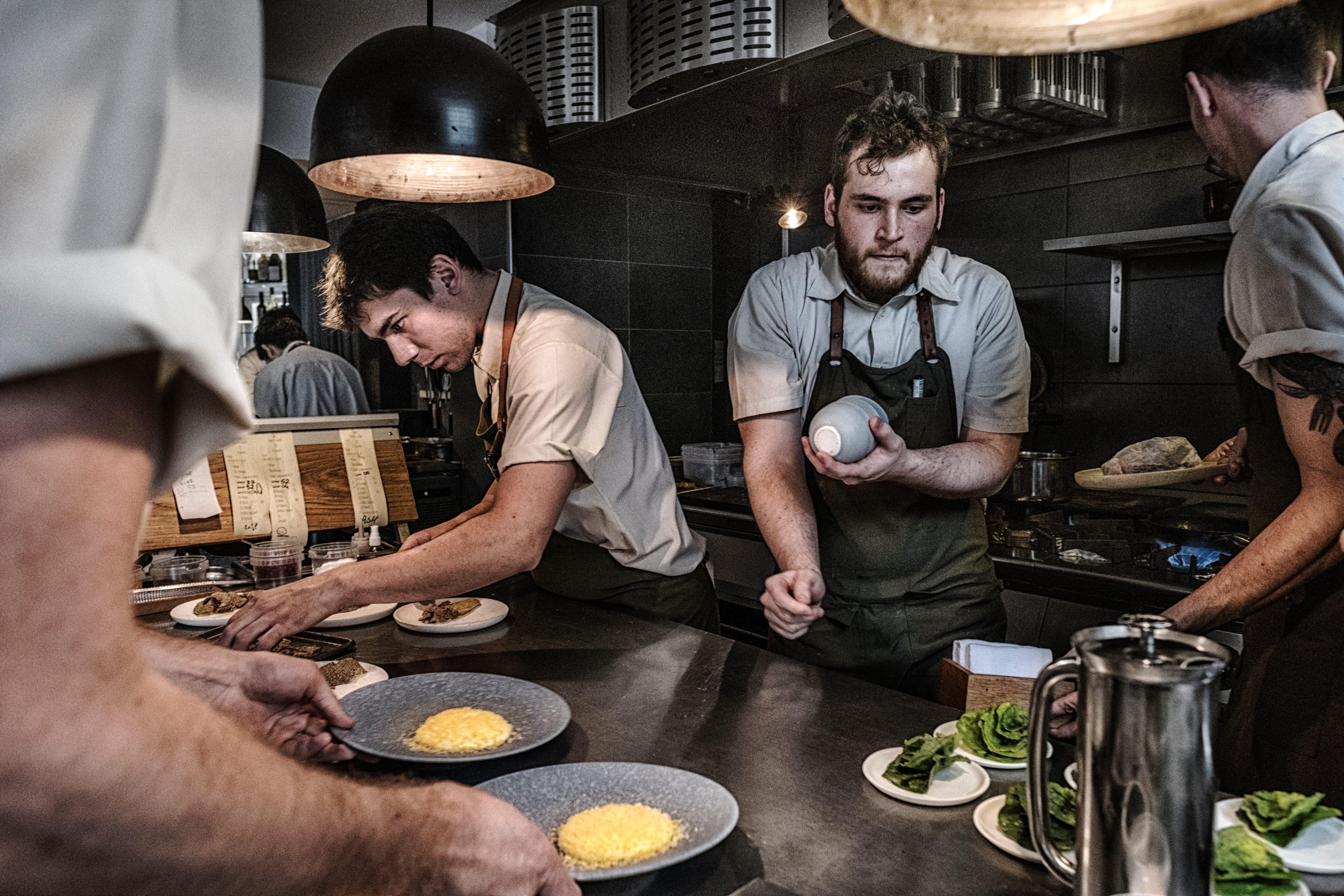
This last week Bruno Verjus from the Table restaurant caused an uproar by closing his restaurants and claiming that fine dining is dead. I speak from some experience with closing restaurants while making some pretty serious declarations, and I very much agree with Bruno Verjus on this one. These are the reasons why:
What is a Fine Dining Restaurant?
First we need to define what fine dining is and what our expectations are of it.
When I started working in this industry at the age of 17, I could not differ between a great restaurant and a luxurious restaurant. Perhaps because at the time–if we omit the great bistro/osterie of the world that were beyond my comprehension– a great restaurant WAS a luxurious restaurant. Fine Dining was pretentious, snobby, primarily French and it catered to the upper caste of the bourgeoisie with working class labor toiling away in the basement or somewhere smelly, all the way in the back. For reasons I cannot explain–I wanted to be a part of that.
My culinary path was yes, a lot of hard work, but also bestowed with a whole lot of luck; I set foot in two kitchens that I believe were paramount to changing the expectations of a fine dining restaurant to something completely different.
At first El Bulli who changed the scope of the chef and made an artist of the craftsman. It gave the chef intellectual relevance that stretched beyond the pleasures of the palate. In me it sparked the confidence that my craft could be even more than the work of my hand, but also an application of my creativity.
Then Noma opened up the kitchen letting the work of the chef be in open display to an audience. In return the new attention now required the chef to engage in the entire experience of the diner within the dining room. The idea of plating a dish ringing the bell and get on to the next was buried. The chefs would now pick up the plates and serve the guests. This was only the beginning.
The fact that a restaurant could meet the guests as equals rather than as a servicing class was the beginning of a substantial change. It made sense that this happened in Denmark, where the inequality and formality is traditionally much less pronounced. To me this quasi-egalitarian model is the greatest impact the New Nordic movement had on gastronomy; way beyond the foraged herbs and the fermented ants.
The role of a chef changed and so did the perspective the position offered. When I entered the kitchen, my purpose was purely craft-based. Chopping, slicing and avoiding getting too deep in the weeds. My job was to rule my tiny domain that connected to others beyond it. The front of house, the somms, the pastry people were like out of town cousins I would occasionally cross paths with at staff food or for late night cigarettes and beers.
A chef’s restaurant
With a deeper understanding of the dining experience, I could now as a chef create a restaurant based entirely on what I believe it should offer; A chef’s restaurant. Relæ was all about having as little fuss as possible, and as much fun as possible. It was based on what I dreamt of when I was standing in the open kitchen at Noma, looking out into the dining room. I took the expansive approach even further where the kitchen was trained and perfectly capable of pouring wines, taking payments and ordering a taxi if needed.
It was the stuff I liked from Noma, minus the stuff I disliked, but more important, it was entirely mine. Or rather ours, as I opened it with fellow Noma alumni Kim Rossen, and a third partner. We were independent, and therefore free to experiment, dream, fail and try again. No luxury, no pretension, no bullshit and based on a small but extremely competent team.
It’s the economy, stupid.
In 2010, moments after the financial crack, this was possible. The lease was cheap, everyone wanted a job, and if the job was fun and interesting, many chefs would be more than excited to join the team. The middle class was strong as hell and the “experience economy” was fueled by it’s finance and search for adventure.
A boom in gastro tourism was picking up speed, and while Noma was attracting worldwide attention supply was nowhere near the demand. In the downstream of the financial crisis, debauchery, opulence and luxury was not vibing. An opinionated culinary experience with character and even a little punk around the edges was valued. It was cool.
In those years, I would spend all my money on dining out, first as a sous-chef and later as a newly made and financially very…. cautious…. chef. Research, inspiration, adventure were possible on a meager salary. Of course it helped that working all the time did not leave many other opportunities to spend the hard fought cash.
During my time there, the Noma menu was priced at 795,- DKK for seven courses and relæ started out with a four course at 325,- DKK! Nomas current menu as of 2026 is set at 4500DKK! I acknowledge that the experience has evolved enormously since, but that is part of the problem.
From Fun Dining back to Fine Dining.
What I was privileged to experience was a time were many cultural and societal circumstances laid the foundation while a handful of talents lead the way for a particular era of fine dining. What we may call the Chef-led Independent Dining, Essential dining, or maybe just Fun Dining. One that opened it kitchens and its doors for the middle class with affordable menu prices and welcoming, fun, experimental and relevant cultural experiences.
One were chefs got personal with their vision and were the diners were unafraid to try something different, something new. It was a time filled with so much hope that for a second, chefs like myself felt they could change the world for the better, one self-harvested, unwasted, fermented leek at a time. It became heavily value based and rhymed with other symbols of a rich society as sustainability; admittedly to the point of nauseating everyone, including myself, one of its main proponents. Like some styles of music define an era, our culinary era has now passed.
Today the landscape has changed drastically. Everything has become very expensive: Fixed costs have steadily risen, quality produce has exploded and wages, while not in equal proportions have done the same. The proposition of an adventure and the excitement of a new project will not have competent staff lining up at the door, nor will it secure you curious guests. They are by now completely overwhelmed with new openings and cannot spare much more than 7 seconds of attention to your carefully crafted opening Instagram reel.
So what are we left with when prices have risen, costs are high and audacity is flattened? The same as in every other modernizing sector: Consolidation, cutting costs, survival of the fittest –but rarely of the greatest.
The wealthy are getting increasingly wealthy, but the middle class is getting squeezed, and the result is that what offers the most bang for your culinary buck has a hard time surviving. If the restaurant industry should stay relevant culturally it must keep a bit of elbow room for its visions, for it’s beauty and poetry. But those are the first thing that are chopped off by spread sheets in the name of financial survival.
The opulence of the old days is back, the experience economy has spiraled into a global phenomenon hijacked by the 50 Best and its and the top restaurants compete for global attention, rather than, lets say a continental one. The experiences at the very top have gone far over the edge in the attempt to satisfy a globetrotting elite that barely feels anything anymore and have resorted to taking pictures of the 53 dishes they are served, and save them in an album with the 32 they had for lunch.
If that is your notion of a great restaurant, you are right to claim that fine dining is not dead, because it is certainly thriving. Catering to the rich was not what I hoped for when I was standing in my own open kitchen, hoping for like minded people to walk in the door. Neither did Bruno Verjus that stated while closing. “If I eat in my restaurant, I am sure I will enjoy it, but when I receive the check I have to admit - c’est tres cher.” Followed by the conclusion that in the end, “we barely make any money” - the menu price is currently at 480 Euro. He continues pondering on what he can possibly teach the next generation, that currently works 35 hours, about a business model that is clearly broken? What is the future that awaits for them?
The evolution is clear in my eyes. The highest echelon will keep becoming more exclusive, and for those of us that are looking for an exciting meal will have to scout for the mad men and women that are willing to apply their creative spirit in the lower ranks, with as much hard work as ever, and with continually smaller financial upsides. I do not belong to the group of critics that finds it all too pretentious and never worth the money. I was in love with fine dining, and I made my teeth there. For a moment it filled me with great hope but now, unfortunately I disagree with Bruno;
Fine Dining is not over.
The fun is.