
I had the pleasure of attending the Convergence Symposium this last week, arranged by Alchemist restaurant and its chef, Rasmus Munk
The real event was the line-up of 170 chefs cooking 5 nights at Alchemist. At a whopping 16,000 (2.100 kr) kroner per cover, it was not for the faint of heart. I considered joining for a (very brief) moment, but decided the one-day Symposium (30€) would cut it to explore the great question of “Is cooking art?”
For the day event, the stage presented Rasmus Munk, a bit of opera, a few other notable chefs like Guzman, Jessica Boval, and Josh Niland, and a few panel talks touching on this incredibly interesting topic.
As it is often the case with these events, it’s very hard to get deep into the weeds of a subject because a debate lasting 30 minutes is not really a debate.
Nevertheless, this topic lives close to my heart, and I came away with loads of inspiration but far more questions than answers. In my mind, that’s entirely a great thing.
After a brief, incredibly smooth introduction by the Danish minister of Culture, Rasmus Munk hit the stage to explain the motivations behind both the event and the cuisine of his restaurant, Alchemist.
Rasmus Munk had goosebumps when he heard the Minister of Culture speak, and so did I. While I was wondering whether AI had already started giving live speeches for politicians, Rasmus was thrilled by the minister’s stated intention to recognize cooking as an art form. “We are actually thinking about it,” the minister solemnly stated in perfect Oxford English. It almost felt like they’d used the wrong AI model – a hint of Danish accent would have made it more real.
Rasmus presented his cooking and broader ideas around one main topic and one main question: Why can we not be considered artists? We being: chefs.
He then explained how a dish of his had created quite an uproar at an earlier conference. The dish was inspired by UNICEF’s appeal to stop world hunger. It was called “Hunger” and after pictures of a starving child, the picture of his dish showed a metal rib cage with a thin veneer of rabbit skin studded with flowers.
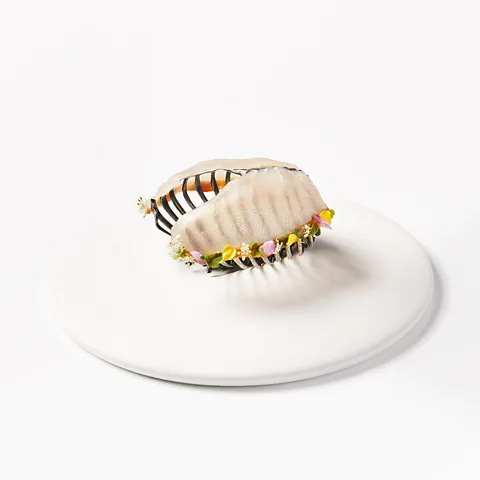
I wonder why that divided the room.
“But why can we not talk about these things?” asked The Best Chef of the Year for two years straight. He proceeded to show pictures of himself thinking and sketching, and asked: “Why can we not be considered as artists?”
As the stage gave space to other potential artists/chefs, something stuck with me that I just could not let go of: Why do we need others to recognize us as artists? Why do we even want the state, the establishments, and politicians–undoubtedly the least artistic people on this planet– to recognize our art?
Art is expression, intent, a gathering of emotions and experiences through a medium of some sort. It can be by watercolor as it can be by wood sorrel stacked in symmetry. If you find it to be art, it is art.
I am deeply perplexed by the fact that what the BBC called “The world’s most Creative Restaurant” in 2023 is asking for permission to be... artistic?
The speakers on stage gave me plenty of material to work with, and I made a video of my first impressions, which you can watch on YouTube.
I wanted to keep this fairly short as an introduction of sorts, and will follow up by writing about a few obvious themes that I found interesting:
Why are Alchemist and Rasmus Munk so focused on guilt and shame?
Cooking is an art, but should it not then put Taste above all?
The difference between craft and art - and cooking and art.
Why food’s utility– and obvious necessity– makes it difficult to consider it an art form - and what to do about it.
If any of this resonates with you, let me know, and I will try to focus on that!
I really enjoyed reading this Chef! It took me back to my early years in kitchens, especially 2018–2021 at Mugaritz. What made that place feel artistically alive to me wasn’t polish or comfort, but the willingness to sit with discomfort, friction, even rejection. Where most restaurants optimise relentlessly for satisfaction, Andoni's vision at Mugaritz was always more interested in the space between satisfaction and disgust, and in what emotions we’re trained to push away.
Dani Lasa who was the very first guest on my podcast once put it very simply when I spoke with him: most of the industry chases pleasure, but perfection often lives at the edge of imperfection. That idea stayed with me. The risk, the controversy, the possibility of failure weren’t side effects, they were the point.
That’s why I sometimes wonder if the question isn’t “is cooking art?”, but whether the restaurant format itself can hold artistic risk when hospitality is structurally designed around comfort, reassurance, and value-for-money. Inviting discomfort is a hard sell in a medium that people also rely on for nourishment and care.
Really appreciate how you’re opening this space up, saw a few of your recent videos and also very intrigued about the upcoming book idea you have mentioned!
fascinating Christian! I just sent you a dm here on Substack -Chef Harrison :)