
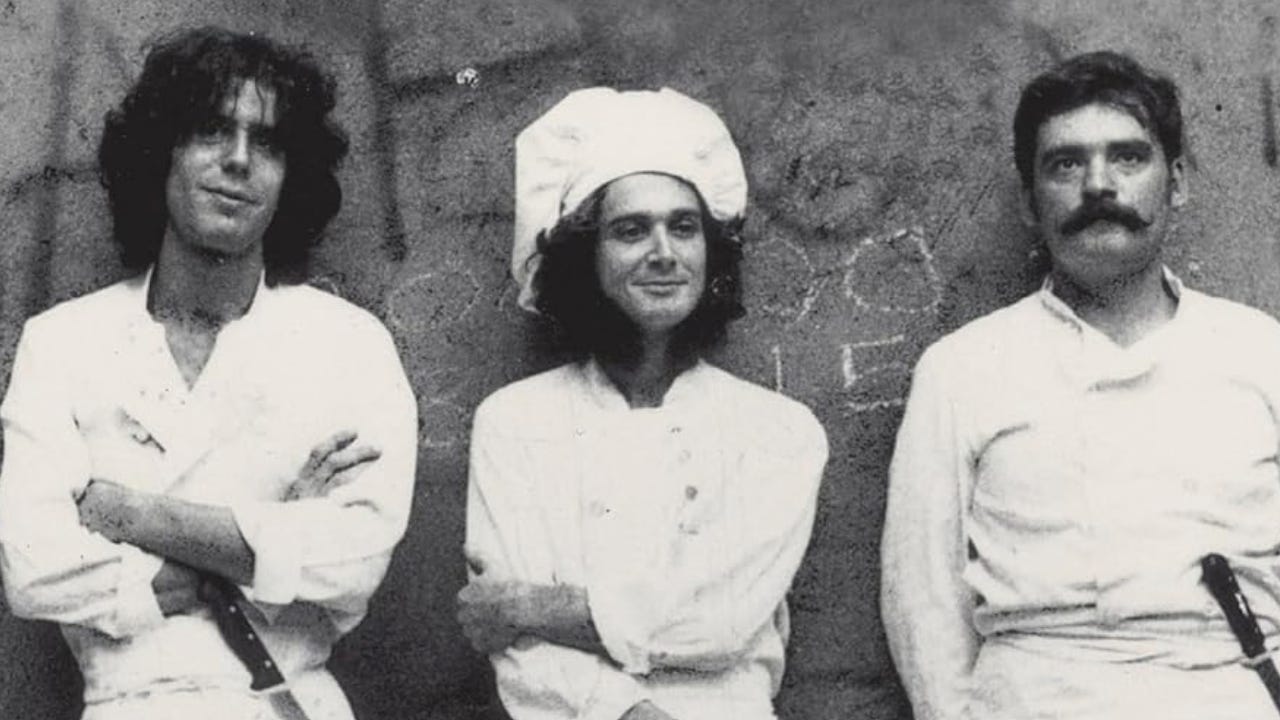
The kitchen life has improved significantly in the last decades. But all improvements come at a cost. I wonder if, in trying to make it more broadly inclusive, we have, by consequence, also excluded someone. What if the ones we have excluded are the ones that need it the most? The people who once endured a kitchen life, long before anyone was paying attention?
I am a chef, and I have worked in the restaurant industry for more than 25 years. I have both been a 17-year-old chef apprentice and a restaurant owner with wages to pay– a worker, and yes, a capitalist. I come from a working-class background, but I have also settled into the ruling class. I’ve seen both sides of the story.
In my last video and Substack piece, I discussed Kitchen Confidential by Anthony Bourdain, and he, more than anyone, gave working-class restaurant people a voice. As Irvine Welsh brilliantly put it in the introduction to Kitchen Confidential: “Bourdain instinctively understands something many bourgeois Marxist critics fail to grasp. Harping on to working-class people about how exploited they are and how wretched their lot is only denies them (their) humanity….”
Cooking in 1999
When I started hospitality college at 17, it was in Copenhagen's old meatpacking district. It was industrial. It was smelly. It was ugly. It was geeky. Nothing about it was cool. But it was all about to change - and Anthony Bourdain played a big part in its transformation.
At the local bodega around the corner, butchers’ apprentices and chef apprentices would gather and slam beers every Friday afternoon. It was foul-mouthed, mostly inappropriate, and it was a lot of fun.
Many of my classmates chose the kitchen path as a last resort, while the ambitious ones chose it fully aware of the hard work that awaited them. Backgrounds were mixed, and expectations were generally quite low.
Cooking was traditionally and historically the worst job you could find. It was what you defaulted to as a voiceless immigrant or someone who was just a single bad decision shy of a criminal path.
It was physical. It was dirty. It was hot. It was barely tolerable. But the job had to get done, and being competent in that kind of environment implied that you had the grit, the stamina, and endurance and, at times, even a level of passion to fuel you through it.
Getting to the very top of that world required enough ambition to make you shrug at the long hours, the swearing and the yelling, and even occasional humiliations. In Kitchen Confidential, Anthony Bourdain paints a vivid picture of what happened when he played it a little smart and thought he was something in an environment that wouldn't let you in without testing you first:
“The other cooks cheered, hooted, and roared at my utter humiliation. Orders began to come in again, and everyone went back to work, giggling occasionally. But I knew I was not going to be the Dreadnought broilerman this year.….. I had been shown up for the loudmouth as useless little punk that I was…..I had been identified as a pretender and an obnoxious one at that.”
I am guilty of all charges.
The chef's cultural position changed as Anthony Bourdain made the outlaw brotherhood cool, and cooking was reframed as something artisanal, expressive, even intellectual across legacy media. Jamie Oliver and Hugh Fearnley-Whittingstall were all over TV and food politics, and the much later convergence with sustainability and organic agriculture made it much more glamorous to put on your clogs and roast carrots all day. The increasingly alluring image of the modern chef attracted a completely different breed of people to work in kitchens.
I'm a perfect example of someone who unknowingly rode the very beginning of that wave. I started cooking at age 17, ready for the hard-knock life, but with time I became heavily influenced by the cultural repositioning of the chef.
This is what eventually made me certify my restaurants organic. What made me establish our own farm. It is what convinced me that my restaurants and I could carry progressive ethical values on top of the business that was essentially cooking and serving food, but that I felt could do so much more.
I had, so to speak, a foot in each camp. I realized today that I have experienced two very different and contrasting eras.
As I was young, naive, and ambitious, I dreamt of working with the greatest chefs, considering them true artists, to the point of working for free just to be near their genius.
By my mid-20s, when I became a sous chef, I started noticing a change in who was coming into the kitchen.
Suddenly, new chef apprentices were no longer troubled youngsters in dire need of structure. They were in their late 20s, coming in full of excitement and inspiration, and with them they could carry a degree in philosophy or sociology. In those years, an academic class entered the restaurant industry from the back door and brought with it a completely new set of demands and expectations that, mostly, have changed things for the better.
During my time, I’ve seen those improvements firsthand, and I’ve appreciated all of it. I’ve never considered myself rowdy or crass or a brawler of any kind. But as I’ve gotten older, I've realized the value of an environment that isn't overly sensitive and isn't afraid to test me out and see if I have what it takes. I understand today how much it helped me shape who I am, both as a cook and as a man. How much I actually needed the pressure, the demands, the structure, and the poking at my ego to eventually become competent and confident.
Newer generations dispute the old ways, and rightfully so, but as the environment grows increasingly sensitive to the behavior of the people populating it, aren't we risking losing something? Or even worse, someone?
A clash of cultures
Now let me be very clear: Just because you’re working class and you can be foul-mouthed, swearing and ill-tempered, does not mean that you are in any way accepting abuse or abusive behavior.
Neither does that mean that you prefer working 16 hours to 8. Or that you don’t want to see your kids every night or work every weekend. None of that is true. None of that is desirable. But there was a time when these unfortunate circumstances created a moat around this industry that has now, for better or for worse, been reduced.
Bourdain successfully described the kind of person that was incompatible with the norms of civilized society but could in the kitchen find himself or herself, for once, useful and armed with a purpose: a culinary purpose.
While improving the working environment of professional kitchens is a valid goal, I wonder if the moral policing that has come with it has a downside. When it reaches a level that suspects any swearing and cursing individual of potentially toxic behavior, without considering what kind of work and pressure he or she has been grinding themselves through for 16 hours a day, for years on end, we make the lives of these hardworking souls even more miserable than they used to be.
In Bourdain’s words: “It is, at the end of the day, still a very difficult business. Some things never change: long hours, cramped working conditions, bad ventilation, relentless pressure, volatile personalities, and the endless, often mindless repetition of a thousand small tasks ensure that only the strong, the serious, and those with a sense of humor survive.”
I’m not claiming the environment shouldn’t be softened or modernized. It is extremely hard work, and there’s a reason I left the professional kitchen. It is rarely a sustainable long-term career path.
Cooking is indeed not an easy life, and for some of us, that was exactly what was required to find a path forward. Restaurants and kitchens are a very special place, but I honestly believe they used to be more inclusive than they are now. I am afraid those who get cut out are the ones who need it most and might also have the greatest culinary potential.
What do you think? Did the kitchen offer you the (flawed) circumstances you needed, or are they entirely a problem to be solved?
This piece connects with the video I made: We fixed the kitchens, did we lose the cooks?