


This topic is interesting, and the “debate” seems to get very heated so I did not manage to pen an answer that could fit a comment section. There is a whole number of criticism and I need more space to unfold my response. I will therefore make this a public letter that you can read:
Lisa Dunbar, Thank you for joining this discussion.
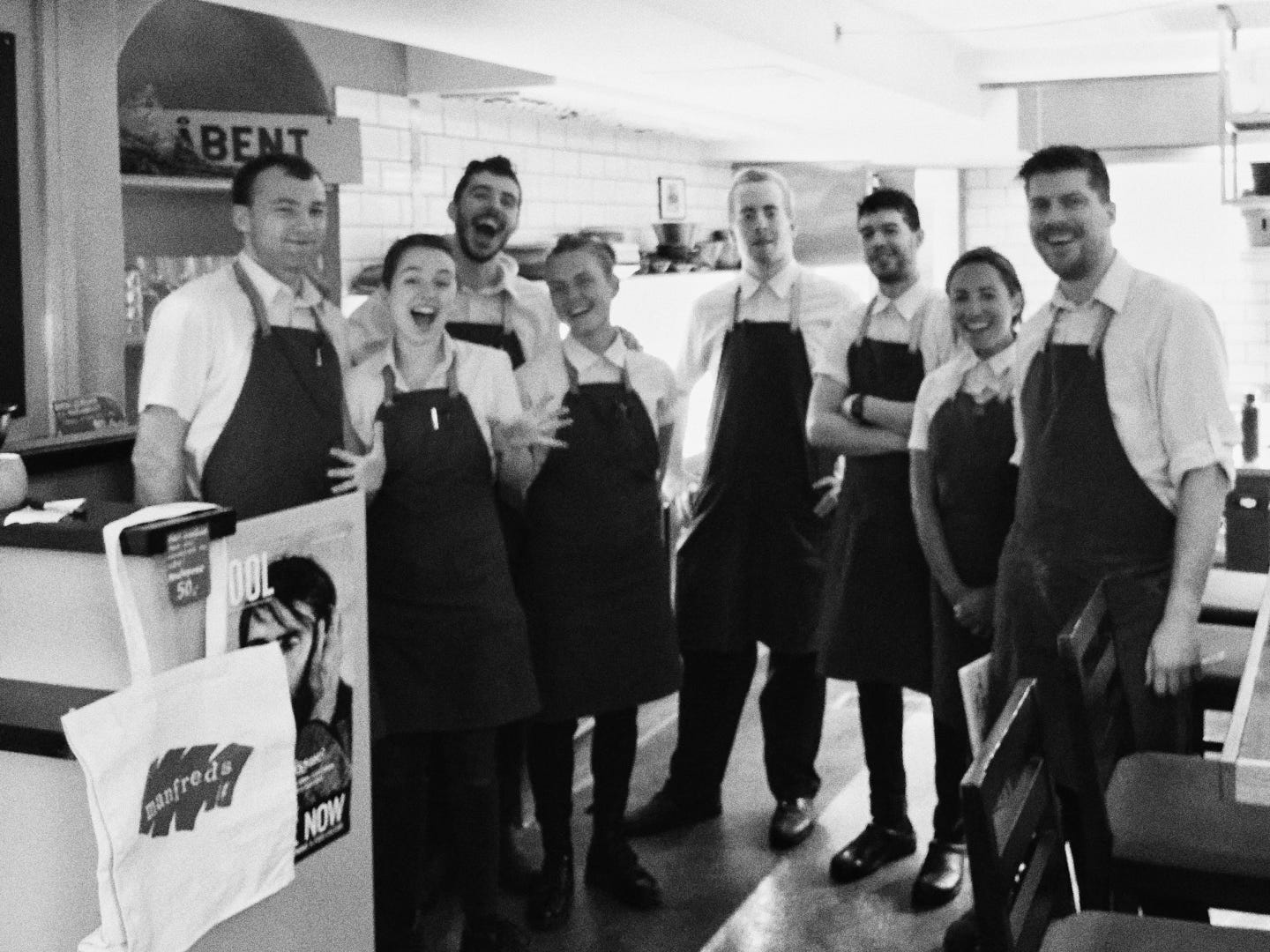
I have fond memories of working with you at Manfreds and I remember you as a talented and engaged part time waiter that was studying to be a teacher. Once you went full time you swiftly became an assistant manager because of your obvious people skills. If I am not wrong you quit the first time to travel to Jura and work with a winemaker whose work we all admired at the time. I believe that was a stage, but I am not certain. You then returned to Denmark, and after a short stint in a winebar you joined us again, this time as a fully fledged manager, and at one point left to pursue studies in environmental design.
Our disagreement
I have not had a longer conversation with you for many years, so please correct me if I misunderstand your standpoint or your story. From the words you use: structural power, labour, exploitation— I believe you are drawing on Marxist theory, with some additions. I find those writings very much worth discussing, and I have studied them since I was a teenager. But I do not, at all, share their conclusions.
They are theories, not facts.
On ideological theory, we have the base of our disagreement: you believe in power systems. I believe in the power of people.
I will not dismiss that a system can create coercion, or that you can find power struggles within those systems. But I find that there’s no change in a system without people, and what people need to make that change is agency. My post is about informing people so they can make the right choices for themselves, as individuals.
You think the system is rigged, and you want it revolutionized, but I have still not seen what alternative your theories present. In 25 years, I have seen plenty of its flaws, and I have given it my honest attempt, with both successes and failures in righting the wrongs I had lived and in shaping a culture I could feel proud of.
The restaurant industry
The restaurant industry is high-pressure at all levels, but especially at the fine-dining level. You have a lot at stake, and the deadlines are many, fast, and the guests/reviewers are often merciless. This is not an environment for everybody, and I acknowledge and accept that some people cannot live within that framework. But some people thrive in it, and that deserves to be acknowledged too. I have been one of those, and I admit it took many, many years to accept that this life was not for everyone. Living under high pressure at all times brings the best and the worst in people. Under pressure, I have seen genuinely good people act in ways they would later fully regret. I have myself made plenty of mistakes under pressure; they have shaped me as a person, and I would not have lived a life without them. Experiencing restaurant life as the worst thing you have ever tried and the best thing you have ever done are both valid points. I believe that 95% of the people that I’ve met in this industry are incredibly resourceful, clever, interested, complex people. Whenever we limit ourselves to focus on structures, we strip those individuals of their agency, and I believe they deserve better.
A restaurant is ultimately a business that lives in the reality of supply and demand. You make the point that capital and prestige gather at the top, and that is simply a reflection of every corner of the capitalist society. I do not disagree that fair distribution is worth striving for from a society’s perspective, I just believe that a business has the right to be a business, and not a social model. What I have not seen, in your argument or in the theories you draw on, is a workable alternative in practice. I speak from lived experience, and I have no doubt missed opportunities to do better. But a critique void of any suggested path forward is just a critique. I welcome your suggestions or your visions, if you have any. If the critique is about capitalism in general, I think you should redirect your energy elsewhere. Let me remind you that I opened my own business 10 years after I started my apprenticeship with no real money to speak of. Restaurants/diners/food trucks/food carts have always been vessels of opportunity for families, immigrants, and hard-working men and women all over the world. They have made dreams possible, and they are, by nature, business models accessible to all classes. Taking a very academic standpoint of privilege that makes restaurants something that serves exclusively the rich and powerful is incredibly simplified and ignores the reality that the vast majority of restaurateurs and patrons face. A fine dining restaurant is not Goldman Sachs, a taco stand is not Blackrock. I cannot think of other industries where so many entrepreneurs are motivated by so much else than cold cash. It can be pure survival, it can be artistic vision, it can be fueled by ego or idealism–I know what it means to run a business and have a vision and anyone who dares to launch themselves into hospitality deserves all my respect, no matter the motivation.
A debate must be free from traps.
I very much appreciate you joining my discussion, and your standpoints are always welcome. Your points had been stronger if you did not fall down to presenting me with a false dilemma: When you ask me to take a stand on talks about abuse in a restaurant I have not worked in for 20 years you are simply asking me to join you in condemnation based on rumors and anonymous accusations or face the conclusion that I am in favour of abuse, which is preposterous. That is a trap, and it is intellectually lazy. This kind of tactic could even suggest that you are not interested in any actual debate, let alone expanding your own frame of thought, but you seek to use me to prove your narrative. I think a debate that seeks to discover the truth deserves better.
The weakness of your theories is that people like me, who have lived, suffered, endured, AND enjoyed the “system”, who have accepted to play by the rules of the game and come out well on the other side, must either be portrayed as villains or exploiters for your narrative not to fall into pieces. Because if the system is rigged, how else can you get to the top if not by exploitation? You have no choice but to dehumanize those who have been successful, because within your logic either people have no agency, are oblivious to the world they live in, or they must be truly bad people. It seems, according to your argument, that the restaurant industry, or maybe the world in general, consists not of complex humans, but only of sheep and wolves in constant power struggle. If I refuse to simplify life to that, a true Marxist will dismiss it as survivor bias: that I necessarily must be blind to the suffering of others, to have anything good to say about this work, this craft, and this industry.
I do not agree. I do not agree with stripping people of their agency, nor do I believe in dehumanizing anyone. I believe in people, and my support goes to those who have the courage to connect their morals with actions in real life, rather than use Social Media as a platform to broadcast moral superiority.
Conclusion
I strongly believe that tactics of public condemnation serve only to create the world you say you want to fix. By setting traps and making debate and genuine discussion risky for those with opposing views, you are not bringing about change; you are keeping people with actual reputations to lose, from offering their perspective. Those are the people who can make the biggest change, but if you hold a position of power and dare to try to do better, the very theories you draw on will be weaponized to cast suspicion on your motives and brand you a hypocrite.
There is no such thing as a non-system, and while I do not believe the system we live in is perfect, I am afraid that the system your theories point toward will only serve to make people more fragile, more dependent, less autonomous, and ultimately less capable to make a good life for themselves. This is not just my opinion — it is supported by substantial research in psychology and behavioral science - I am refering to Jonathan Haidt and Nassim Taleb amongst others.
And yes–I do condemn abuse.
Both in real life and online.
Dear Christian,
Firstly, thank you for engaging in this discussion. I respect the seriousness of your position, and admire both your intellectual grounding and the weight that your lived experiences carry, particularly your time at Noma and El Bulli.
For transparency, I staged at Relæ twice in 2016 and 2017, and my experience was of a fair and mutually valuable exchange. I gave my time and labour in return for practical skills, technical insight and an inside view of your business and way of thinking. Those weeks remain among the most inspiring of my career.
That said, I was able to exercise agency in a way not everyone can. I was in my thirties with solid experience working in many kitchens, including my own. I could contextualise what I was seeing. I could take paid leave and expense the travel. My circumstances are the exception to the rule.
This is where privilege enters. Agency is not only maturity and knowledge — it is material security. Had I been a younger adult, with no savings and limited professional footing, would the exchange have felt the same? Perhaps. But it is far less certain. That feels worth examining, not to indict, but to understand. Particularly in the context of highly decorated restaurants with a greater reliance on stagieres than your own.
This train of thought raises something practical: is there scope for clearer industry norms around staging — a recognised framework, a shared set of expectations between stagiaire and host, even some form of syllabus or structured educational programme? It may be unrealistic to implement something industry-wide, but this is precisely where 'progressive' industry leaders and business owners should be more proactive. When unpaid or low-paid labour forms part of a business or industry 'system', clearer parameters, responsibilities and educational outcomes should be placed at the forefront.
I realise there are now many exceptions, but historically this structure has been at best informal and at worst non-existent. Without defined standards, the agreement risks becoming ambiguous. That ambiguity is where the critique we are currently experiencing rightly gains force.
There is one further point I feel compelled to raise, although it is uncomfortable.
Lisa has spoken about feeling fear in her workplace at the time. That may be dismissed as her own personal perception, but I don’t think we should rush to do so. As male business leaders in an industry with a documented history of coercive behaviours, we carry responsibility to examine not only intent but impact.
In my own interactions with you, I never felt fear. I felt humble and dare I say honoured, but any exchange we shared felt like it was bound by respect. But I experienced that environment as a confident, established male professional. Would a young woman in her early twenties have felt the same ease within the hierarchy? I don’t know. That uncertainty alone warrants reflection.
Gender inevitably complicates this conversation. Structural inequalities — to borrow the language being debated — can be intensified when viewed through that lens. It intersects with questions of power and agency, however we frame them.
As someone who now hosts stagieres and leads a team, I am conscious that how I behave — especially as a male employer where younger females are concerned — has the potential to shape someone else’s sense of safety and belonging. That awareness feels central to whatever progress our industry makes next.
To be clear: my experiences staging at Relæ and maybe half a dozen other likeminded restaurants are almost entirely positive. I do not view staging as inherently exploitative. But I do believe that as industry leaders, we have a responsibility to formalise the conditions under which opportunity is offered. If we believe in agency, we should ensure the conditions exist for it to be meaningfully exercised.
With respect,
Nicholas
I think this conversation is being distorted by two things: 1. A focus on the very top few restaurants 2. This idea that restaurants “rely on” unpaid internships.
There are thousands of incredible places doing excellent work. You can absolutely use an unpaid internship as a way to get in the door and learn with no prior experience and a great attitude and determined work ethic. This process has proved valuable to many many people including myself. Focusing on the “top” restaurants insures this. Furthermore, I don’t see enough discussion about how much work it takes to host unpaid interns. When I have taken on stages it slows my day down even though it is well worth it to have an educational model and be able to cultivate talent rather than hire talent. If I get a case of chickens in from the farm I can break them down pretty quickly. It takes me at least three times as long to teach and monitor a stage. When they master that task they go on to learn something new and the process repeats itself. Once they’ve done enough of that and there’s an open spot for hire, these are the folks who get the spot. Not to say the system is perfect, no system is, but when it works it’s a beautiful thing.