
Many friends, peers, and old colleagues are shivering with excitement and fear over tonight’s Michelin awards gala.
Melbourne to Copenhagen
It was a very different experience when I received mine in 2012. There was no such thing as a gala, first and foremost, no embroidered Bragard whites, and there were much fewer stars shining onto the Scandinavian scene. We did not even have our own guide; Main Cities of Europe was a collection of the top restaurants in the European capitals, with a little sprinkle of the fringes, including Copenhagen, Oslo, and Stockholm. You got the news on the date of publishing. By someone telling you, or calling you up. Someone knew, mostly Jan Restorff.
I had the privilege of everyone else knowing before me, as I was with Kristian Baumann, traveling home from Melbourne, as the guide was published. As I toggled off the tiny airplane I was up for a great surprise: my phone exploded with congratulations and warm wishes. “Tillykke!” Congrats! At first, I was so taken aback by the news that I barely had a reaction. We got a Michelin star.
Built to Break the Mold
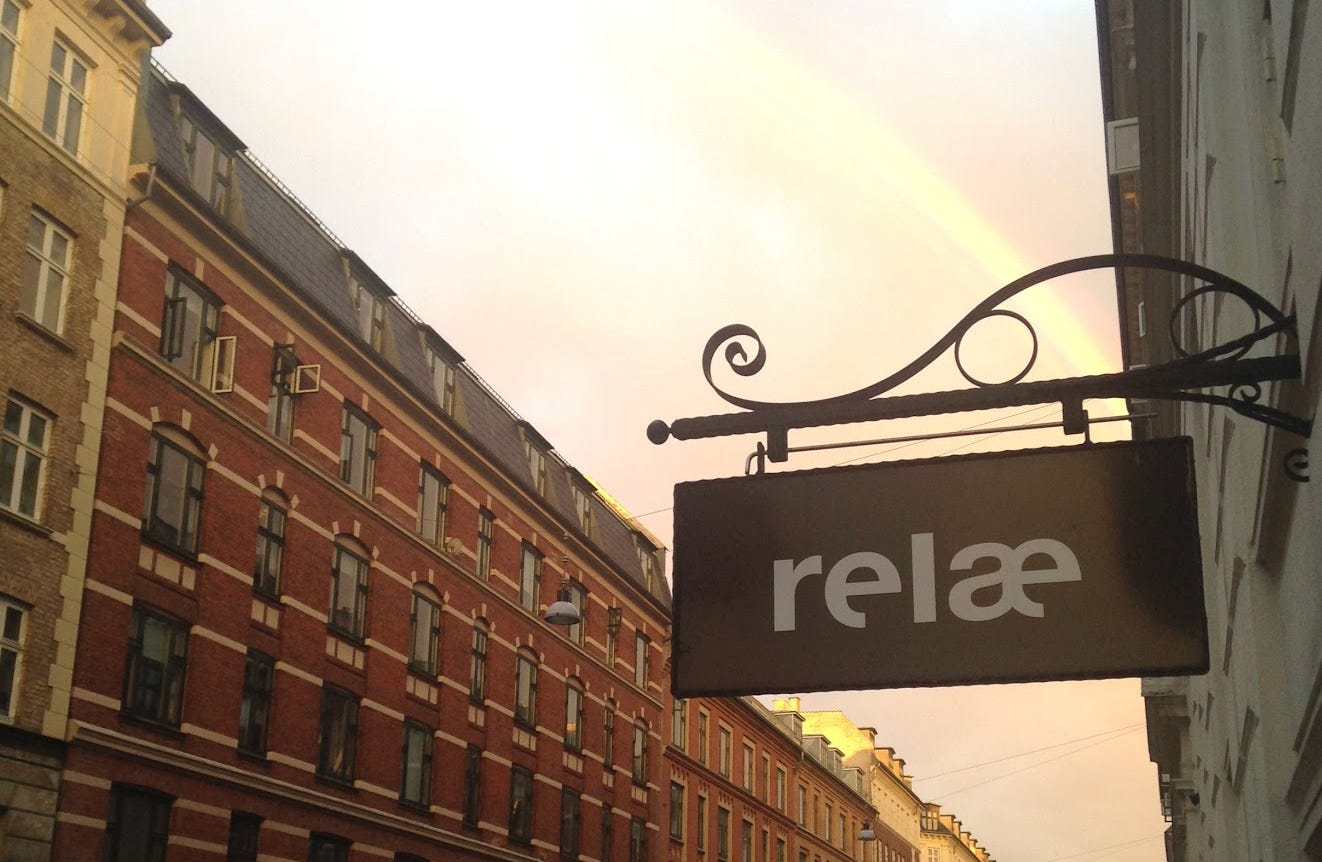
Relæ was from the first day an improbable candidate for a star. In a small and crowded basement, the tables were lined up so closely that an average-sized thigh could only just squeeze through to slide onto the benches along the window. Not all thighs are admittedly below average, so the late Kim Rossen would spot the need to pull tables 6 and 7 apart way before the lady had returned from the wardrobe, where she would awkwardly find a place for her jacket after checking in with a reservation. The music was loud, and the general attitude demanded the same level of attention: You are here for us; we are in charge; the customer is rarely right, and when he/she is, it is because he/she agrees with us. The food was not trying to please anyone, and while some were ravished by the culinary ideas, some absolutely hated it–that was exactly how I wanted it to be. There is no art in pleasing everyone, except, I guess, the art of hospitality, but that was not on the agenda at the time. We were punk-rocking-cooking.
After years of culinary adventures, I had grown as enamored by the idea of a creative cuisine as I had gotten annoyed by the bothersome luxury whose existence it always seemed to require. I wanted to place my cuisine as far away from the thick tablecloths, the expensive cutlery, the quiet whispering, and the forced French accents as I possibly could. As far from Michelin-turf as possible, and I justified all of it by keeping the prices low enough to not mind the haters, and by picking a location so much off the beaten path that stumbling into the restaurant required more than just bad luck. It required intention.
The Teenager and the Guide
My antipathy towards the allure of the guide was perhaps a continuation of my teenage-style restlessness that more than anything else defined the beginning of Relæ. My need to find myself at all costs. A process most often started by revolting against the institutions that made you, or in other words: your parents. I was despising the fine-dining scene that made me fall in love with cooking and perhaps, like a door-slamming teenager, I was yelling at my parents while secretly needing their recognition. Perhaps. Whatever it was, it bubbled up within me, as we were heading for the luggage and soon for celebrations at the restaurant. I broke down sobbing. Overwhelmed, and surprised by my overwhelm: I was now a Michelin starred chef. It had been a dream, it always had, even when I was denying it.
The Shackles
I have zero skin in the game today. I root for my friends, for the ones I know have shared my dreams and worked just as hard, if not harder. Kristian Baumann has, on his own account, received two stars from the get-go, and John Tam proved with Jatak how much of the credit he deserved for the culinary success of Relæ. When Relæ was awarded a star, there were only half a dozen stars in Denmark. I believe that tonight’s award ceremony will bring us past 50 stars, but that does not take anything away from anyone’s particular experience with receiving it. The main advantage Michelin has over its competitor, The World’s 50 Best, is that it is a positive-sum game; there are enough stars for everyone, and while that might make the competitive landscape more difficult for the business side of things, where exclusivity is king, it does allow room for recognition wherever it is due. The list model is more enticing to a spectator and makes for much more drama, but for anyone to move forward, someone must go back.
My experience was special to me, as everyone’s experience will be. What I find most proud in hindsight is that we received the star, as we were placed on the 50 Best, not by design, but in spite of who we were and what we wanted. We were recognized for being unique, for NOT fitting the model. Not only is that to me personally a badge of honor, but it was also liberating in the sense that the ambition for a star was never to me what it often is to many chefs: shackles that keep you imprisoned until you finally get the damn star. Only to then be replaced by a new set of shackles — the two stars and a fear of losing a star. All of which, of course, is much worsened as the second star is achieved and the 3rd comes within reach. An endless cycle that can consume anyone, but who is to blame? The Guide?
What It Actually Is
I have more sympathy now that I have gained a little more distance towards those for whom the star is everything. I understand the need for recognition. I believe I had it, but just expressed it differently. In the clarity of hindsight, I also want to remind those who tend to forget that the Michelin guide is there to sell tires, not to make you happy or even to judge you fairly. No one is capable of understanding the complexity of a restaurant and judging its excellence, performance, flaws, high notes, and shitty days as the people working within it, at least if they are equipped with the right amount of self-awareness. No reviewer, no returning guests, no Michelin inspector. The Guide has made decisions that seem completely senseless unless motivated by a secondary agenda that the public does not have access to. It is a marketing tool to sell tires; its shift from secrecy towards Galas is a clear attempt to sell out its marketing power and access to sponsors. The chef community is caught in the middle, as a puppet trapped by the cultural and historical significance of the star, the economic interests of investors, and the particular mood of a particular inspector, all of it further complicated by decision-making that takes into account much more than the particular level of a restaurant on a particular day.
A Preferred Indifferent
I am not here to say that it does not matter. It matters. If you get one or another, please do get absolutely smashed in Tivoli and add a memorable headache as a souvenir. But if you don’t, treat it for what it is: what the Stoics called “a preferred indifferent.” And do the same with all external recognition; don’t count on it or, like I did, pretend it doesn’t matter until you get it so you can enjoy it fully in big gulps. It is not like the lottery, but almost. Don’t count on it, but let yourself celebrate if you do! You can only control what you set out to do, and be your own worst critic about whether you got there or not. The rest does not matter. That much.
Good luck to everyone tonight!
I did a video on this:
I have just begun consuming your content via substack, Youtube and such. Lesson 1) you write really well, not convoluted, to the point and clear. 2) your story is quite unique, and you made it work. Hope to run into to you in Roccalumera, Letojanni, or somewhere on the sunny coast of that amazing island.
I really enjoyed this. Coincidentally, this week I had the pleasure of dining at Maeda in Kyoto, a former three-star restaurant that chose to step away from the Michelin system and operate "privately". With the help of translation apps, it was interesting to hear the chef's perspective on recognition, expectations, and freedom. A lot of what he shared echoed your writing!!